Kofi Annan Quotes
We tend to look at countries in terms of failed states and functioning states, which is rather simplistic.
Annan, Kofi. Interventions: A Life in War and Peace. Penguin Press, 2012.


Some of America’s very difficult counter-insurgency efforts like Vietnam, Iraq and Afghanistan have been problematical since Burt’s necessary popular national government was not in place in these efforts. The governments were corrupt, incompetent, and uncaring about the majority of people. Arguably, if there were a “responsive and politically popular national government” in place, there may well have not been a serious insurgency to begin with.


Even in modern times many politicians the world over agree with Davis’s point that for a government to function well, the nation must have a homogenous citizenship. This is especially true of dictatorships where control of a uniform culture and populous is easier than if it is diverse nation. In modern times, the three greatest economic and scientific powers, the United States, The Soviet Union, and China were and are multicultural societies with different ethnicities, races, religions, and cultures among their sitizenry.

There are many who disagree with Stewart on two grounds. First, the failed state sill not use the aid reasonably and it will wind up in the pockets of war lords of terrorist groups. Second, the failed state often becomes a safe haven for terrorist groups to operate and train from.


Under Italian Fascism, the only person who determined what was or was not in the national interest was Mussolini himself.


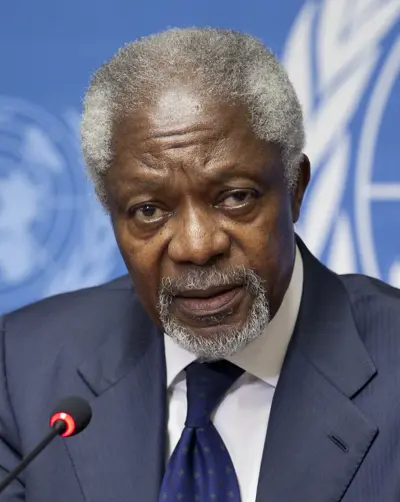
Kofi Atta Annan was a Ghanaian diplomat who served as the seventh Secretary-General of the United Nations from January 1997 to December 2006. Annan and the UN were the co-recipients of the 2001 Nobel Peace Prize. He was the founder and chairman of the Kofi Annan Foundation, as well as chairman of The Elders, an international organization founded by Nelson Mandela.
