Antonin Scalia Quotes
We should start calling this law SCOTUScare ... [T]his Court's two decisions on the Act will surely be remembered through the years ... And the cases will publish forever the discouraging truth that the Supreme Court of the United States favors some laws over others, and is prepared to do whatever it takes to uphold and assist its favorites.
Scalia, Antonin. Dissenting opinion. King v. Burwell, 576 U.S. 473, Supreme Court of the United States, 25 June 2015, p. 515.


He uses the term, “Non-interpretivism”, in a judge’s decision to indicate a judge who does not accept the interpretation of the Constitution as written and intended by the framers. His bias is a conservative one and this is how he views decisions that he does not like. When liberals see an opinion with which they do not agree, they also very often accuse the judge of activism and not adhering to the framer’s intentions. Generally it is a question of “whose ox is gored?”

Amicus Curia is Latin for Friend of the Court. In the American legal system, in any appeal case any organization or individual may file a brief to the court even though they are not on either side. Some like Brest do not like these briefs because they are not for either side but just want to benefit the country and the society. Others think that these are the best brief’s because they consider the big picture and not the specific parties to the case.


This quotation is particularly important because it summarizes one of two opposite schools or thought regarding judicial interpretation of the Constitution that politicians have been arguing about since the Supreme Court first sat. The other is Original Intent where only the original intentions of the writers and ratifiers of the Constitution should be considered—assuming that it can be determined.


Two openings appeared on the Supreme Court for Nixon to fill. He heard from many people on recommendations, but he wanted to fill the posts with “strict constructionists.” Rehnquist had written giving him a political operational definition of a strict constructionist. This memo was never released to the public by the White House on the grounds that it was protected by Executive Privilege. However, the definition given had virtually nothing to do with the concept of strict construction but is a definition of a ideological conservative constructing his own meaning to the Constitution. The source for the text came from John Dean, the Counsel to the President, who found this memo in his White House file and revealed it at a question and answer session at the Commonwealth Club of San Francisco, October 10, 2001.


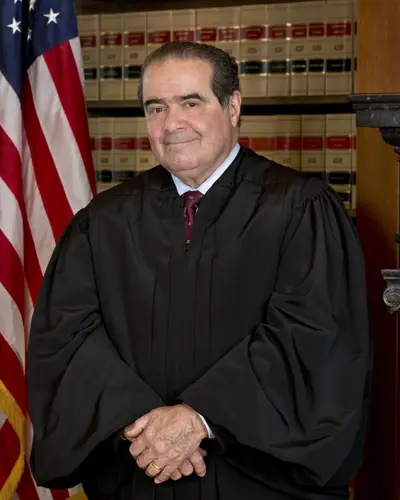
Antonin Gregory Scalia was an American jurist who served as an associate justice of the Supreme Court of the United States from 1986 until his death in 2016. He was described as the intellectual anchor for the originalist and textualist position in the Court's conservative wing. For catalyzing an originalist and textualist movement in American law, he has been described as one of the most influential jurists of the twentieth century, and one of the most important justices in the Supreme Court's history. Scalia was posthumously awarded the Presidential Medal of Freedom in 2018 by President Donald Trump, and the Antonin Scalia Law School at George Mason University was named in his honor.
