Henry Cabot Lodge Quotes
We shall make reservation after reservation, amend and amend, until there is nothing left.
It worked exactly as he planned.
Henry Cabot Lodge, 1850-1924, U. S. Senator (Republican, MA), Strategy for killing the League of Nations, 1919
Sourced by: Eigen's Political and Historical Quotations


Actually, the insistence on 60 days had nothing to do with having time of members of Congress to study the treaty and make up their minds. It was intended by the opponents of the treaty to give them time to whip up public opinion so such a degree that it might derail the treaty. But if they said that, and the President said, "No", they would lose. But couched this way, if the President refused, they could say that the President and supporters of the treaty were afraid that the public and the press as well as they would have the time to see the weaknesses and just wanted to "ram" the treaty through. So they either get the time or they create suspicion of the treaty in many minds. Unfortunately, what is good politics is often hypocritical and frequently intellectually dishonest.


In response to Administration tactics to delay a vote on the Church-Cooper proposal to limit American involvement in Cambodia after June 30, 1970, Senator Cotton asserted:


The United Stats Senate until the hyperpartisanship and the Republican abuse of the filibuster in the early part of the 21st century, was considered by most, the greatest deliberative body in the world. In just a few years it became one of the most feeble.


Viscount Cecil of Chelwood. He did a remarkably good job in drafting the initial covenant of the League of Nations. Many believe that one of the reasons was that he was not encumbered by having specific instructions from his government and by not being very politically involved. And the government, in turn, remarkably did not take control of the process, but saw it as a technical, professional task and left it to Cecil.


She was referring to the health care reform that she had led which was very similar to the Obama Health Care Reform which was passed over a decade later.

Despite having passed the House and a majority of the Senate favoring McCain’s bill, a filibuster was led by a few holdouts from his own party. Patiently, McCain assembled sufficient Senate support to break the filibuster.

In the early days of the Senate Filibuster, a senator could hold the floor (and halt all actions) as long as he could continue to speak or 3/5 of the Senate voted to end the filibuster. The filibuster imposed a physical burden on the Senator who chose to use it. Likewise, the other Senators had to be present in sufficient numbers to have a quorum, else the Filibusterer would be able to rest at he did not have to continue to speak if there was not a quorum. The Senate rules were changed to allow a Senator to “announce” a filibuster of a bill, and all action on that bill would stop but there was no burden on the filibustering senator or other senators who had to form the quorum. But in the 112th Congress, the Republicans resorted to more filibusters than there had been in the entire previous history of the Senate and Nelson wanted to return to the old requirement of holding the floor physically.


The senator sees examples of the filibuster in ancient Rome.

This quotation is an example of the political extremes that can occur when there is hyperpolarization in American politics. In this case the Republicans had enough power in the Congress to prevent the Democrats from passing any legislation to fix any of the problems in the Affordable Health Care Act, the way normal large legislation is amended after it is passed, and problems and unexpected consequences are revealed. The Republican strategy was to prevent the bill from being fixed, lest President Obama and the Democrats could claim victory, while they could point to the consequences of the problems to show the Democrats passed a bad law. It was better for them to criticize the Democrats than it was to improve the law and the services to citizens. This was very rare because usually both parties, after a bill passes, help to fix flaws and improve the bill regardless of whether or not they opposed it originally.

This is an important political quotation because it illustrates one of the major reasons that Congress was so gridlocked at the time and passed hardly any legislation at all. Farenthold was a relatively new Congressman supported by the Tea Party extreme conservatives. He had no Congressional legislative experience and viewed the House / Senate Conference Committee process more like a Middle East rug bazaar than a serious democratic process of constructive legislation. The position that he wants to take to the Conference Committee which is “livable” to him is not only unlivable to the majority of the Senate, but unlivable for a large part of his own House of Representatives, His position is so extreme that most Senators and many House members on the Conference Committee do not even bother to attempt to negotiate from there. Experienced Congressional legislators realize that negotiation can only take place between realistic options. Otherwise no legislation gets passed which was at that time, OK with most of the Tea Party supporters.

They were discussing the Civil Right Bill of 1964 which they all wanted to pass. See {605438} . However, they faced a filibuster from the Southern Senators who had always before used this tactic and blocked Civil Rights legislation. However, the President here committed himself to the one way to take most of the power out of the filibuster. Accept a shutdown of the Senate, give up the rest of the President’s legislative program but the filibuster blocks all legislation that the Southerners wanted like cotton and tobacco subsidies.

The majority of the country strongly favored American participation in the League of Nation provided there were some reservations that made it explicitly clear, the American troops could not be committed without the approval of Congress and that nothing would impinge on U. S. domestic sovereignty. Wilson wanted no exceptions or reservations to the treaty he had negotiated and would not compromise in any way. The issues were soon forgotten in what had become a test of will and power between the Senate and the President. The treaty was never ratified and without the United States, the League of Nations collapsed.
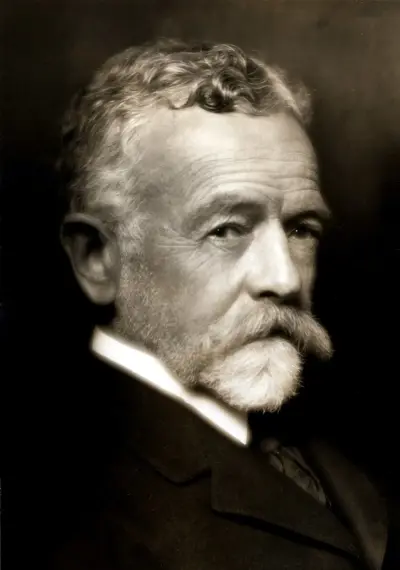
Henry Cabot Lodge was an American Republican politician, historian, and statesman from Massachusetts. He served in the United States Senate from 1893 to 1924 and is best known for his positions on foreign policy. His successful crusade against Woodrow Wilson's Treaty of Versailles ensured that the United States never joined the League of Nations and his reservations against that treaty influenced the structure of the modern United Nations.
