Robert Byrd Quotes
We must not allow any president to unleash the dogs of war at his own discretion and for an unlimited period of time.
Robert Byrd, 1917-2010, U. S. Congressman & U. S. Senator (Democrat, WV), Senate Majority & Minority Leader, “Congess Must Resist the Rush to War”, New York Times, October 10, 2002
Sourced by: Eigen's Political and Historical Quotations

The president did not act purely on his own. The operation in Libya was a NATO operation, not a U. S. operation. All NATO countries unanimously approved the enforcement of the No Fly zone and it was approved by the Security Council of the United Nations, Technically the operation was not war. NATO and the United States was asked to support the no fly zone by the Government of Libya which we and the other countries all recognized at the time. However, since the later part of the 19th century, America has debated exactly who and under what conditions can commit U. S. Troops to hostilities. The prerogatives of Congress in the war powers debate have eroded to the Presidency in the last 2 centuries and some, like Paul feel that the older balance should be restored.


When the Senate was debating the Gulf of Tonkin Resolution, which would empower the President to take "all necessary measures" to repel any armed attack on U. S. forces, Senator Morse was one of only two Senators opposing the resolution:


See {592811} for Adams response.


President George W. Bush initiated an invasion of Iraq based on the fact that Iraq was developing nuclear, chemical and biological weapons. After the invasion however, there were none of these weapons found and much evidence that there were not any at that point in time. By the time Congress, the body which is supposed to declare war, found out that the reason for the war was bogus, it was too late. We had already occupied the country and were in the midst of a civil war. The President either acted on bad intelligence or wanted to invade Iraq for other reasons and history may finally tell us which, but Fein sees the problem as too much secrecy in the executive branch.

Alberto Gonzalez, White House Counsel and later Attorney General who was forced to resign and David S. Addington, Counsel to the Vice President, had come up with a novel view of the powers of the presidency. They argued that since the President is the Commander in Chief, in a war situation or intelligence gathering thereto, has the Constitutional responsibility for that function, he need not obey any laws of Congress as in the conduct of the war Congress would be impinging on the Constitutional separation of powers which itself was prohibited by the Constitution. The argument did not find any significant legal support but for a while the George W. Bush White House behaved as if this were the law, despite the fact that even in the American Revolution and the War of 1812 Congress passed laws regulating the conduct of the armed forces as is provided for in other parts of the Constitution. Yet even Goldsmith would allow the President some powers that many think are unconstitutional and/or belong to Congress. See {32436}.

WWII has been remembered as a “good war” which had the overwhelming support of American at the time and in historical retrospect.


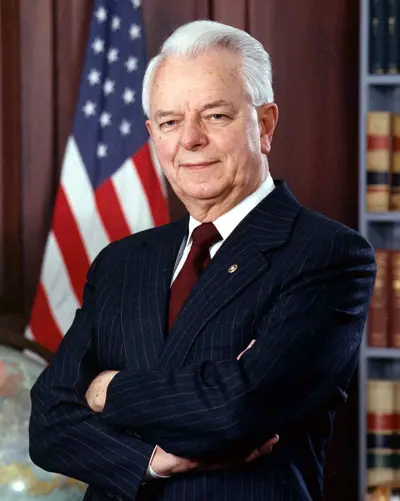
Robert Carlyle Byrd was an American politician who served as a United States Senator from West Virginia for over 51 years, from 1959 until his death in 2010. A member of the Democratic Party, Byrd also served as a U.S. Representative for six years, from 1953 until 1959. He remains the longest-serving U.S. Senator in history; he was the longest-serving member in the history of the United States Congress until surpassed by Representative John Dingell of Michigan. He was the last remaining member of the U.S. Senate to have served during the presidency of Dwight Eisenhower, and he was the last remaining member of Congress to have served during the presidency of Harry S. Truman. Byrd is also the only West Virginian to have served in both chambers of the state legislature and both chambers of Congress.
