Ernest Hemingway Quotes
We in America should see that no man is ever given, no matter how gradually or how noble and excellent the man, the power to put this country into a war
Ernest Hemingway, 1899–1961, Nobel Laureate in Literature, “Notes on the Next War: A Serious Topical Letter", Esquire, September 1935
Sourced by: Eigen's Political and Historical Quotations

President Eisenhower was asked if there was any danger of the country getting inadvertently drawn into a war in Vietnam as the result of sending military "advisors":

In 1949 the NATO treaty was signed. There was concern that a phrase in the treaty authorizing signatories to take "such action as it deems necessary, including the use of armed force" would undermine Congress's powers:


An earlier version was written by Congressman Louis L. Ludlow, 1873-1950—see his quotation about it—{39681}. The proposed amendment was narrowly defeated.


When the Senate was debating the Gulf of Tonkin Resolution, which would empower the President to take "all necessary measures" to repel any armed attack on U. S. forces, Senator Morse was one of only two Senators opposing the resolution:


At the time of this speech virtually the entire world believed that. However world attitude changed markedly after the administration of George W. Bush and the United States invasion of Afghanistan after September 11 and the Iraq War which was for regime change.

The president did not act purely on his own. The operation in Libya was a NATO operation, not a U. S. operation. All NATO countries unanimously approved the enforcement of the No Fly zone and it was approved by the Security Council of the United Nations, Technically the operation was not war. NATO and the United States was asked to support the no fly zone by the Government of Libya which we and the other countries all recognized at the time. However, since the later part of the 19th century, America has debated exactly who and under what conditions can commit U. S. Troops to hostilities. The prerogatives of Congress in the war powers debate have eroded to the Presidency in the last 2 centuries and some, like Paul feel that the older balance should be restored.


WWII has been remembered as a “good war” which had the overwhelming support of American at the time and in historical retrospect.


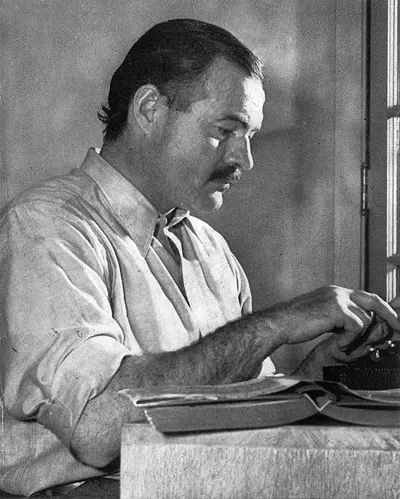
Ernest Miller Hemingway was an American novelist, short-story writer, journalist, and sportsman. His economical and understated style—which he termed the iceberg theory—had a strong influence on 20th-century fiction, while his adventurous lifestyle and his public image brought him admiration from later generations. Hemingway produced most of his work between the mid-1920s and the mid-1950s, and he was awarded the Nobel Prize in Literature in 1954. He published seven novels, six short-story collections, and two nonfiction works. Three of his novels, four short-story collections, and three nonfiction works were published posthumously. Many of his works are considered classics of American literature.
