Clement IX Quotes
We excommunicate and anathematize … all those who take to the Saracens, Turks and other enemies of the Christian name, horses, weapons, iron, iron wire, tin, copper, bandaraspata, brass, sulfur, saltpeter, and all else suitable for the making of artillery, and instruments arms and machines for offence …
The pope attempted a boycott of weapons against the Ottomans who were threatening Crete, then controlled by Christian Venice. The French and others did not respect the boycott. As in modern times, boycotts were easily broken by those wishing to profit from trade. Crete fell. The Catholic boycott had actually started in the 16th Century with minimal effectiveness, but Clement IX made a vain effort to enforce it.
Clement IX, 1600-1669, Catholic Pope, Papal Bull
Sourced by: Eigen's Political and Historical Quotations


The Bull was directed at French King Louis VII. On Christmas Eve the year before Zengi had broken into the city of Edessa and massacred the French inhabitants. This was the Proclamation of the start of the 2nd Crusade. Note that the Pope, in order to raise troops and money for the Crusades, used the remission of previous sins to motivate Pietro dei Paganelli di Montemagno

Slogans taken from posters listing 10 people targeted by Muslim extremists. Most were people who had said or published material that some fundamentalist Muslims had decided were offensive to Islam. One was Charlie Hebdo, the French Publisher who Islamic terrorists murdered later. Note the Americanisms that the terrorist propagandists adopted. The Wanted Dead or Alive was taken from the posters of the American West of the 19th century. The "Yes we can" was lifted from the Barack Obama 2008 campaign slogan. The "Bullet A Day Keeps the Infidel Away" is a takeoff on the American saying "An apple a day keeps the Doctor away." One of the reasons for these Americanisms was that the founding editor was Samir Khan, self-described American traitor.

“Musselman” was then a term for Muslims used by Europeans. The Arabs then, as many terrorists still do, commonly captured American and European ships enslaving the crews and passengers or holding them for ransom. Jefferson and Adams explained that if this could not be stopped and resolved it might mean war. The Americans could not understand why they were attacked when American had done nothing to offend the Arab Counties. The Arab envoy explained their “duty” and “right” to attack Americans and why war was not a serious deterrent to Islamic nations. Ironically, the same explanations were given by Arab leaders in the early 21st century to illustrate why the Arab countries could not be intimidated.
This characteristic of much of Islam is corroborated by Islamic scholars and politicians. To some, the implication is that it is foolish to negotiate with Muslims over issues that have been classified as jihad. The negotiation is only a sham which will go on until Islam feels strong enough, and then force and violence will be used. While this is historically and culturally true, many Muslims have modernized and see the world in terms of vested interests and negotiated settlements and compromise just like most others. And there have been many non-Islamic ideologues who have also used negotiations and diplomacy as a smokescreen to buy them time to strengthen militarily and then have used force and violence.

She is a leading American Arab who is a Syrian expatriate.

This sura is one of the quotations that causes major anxiety on the part of the Israelis. If the Arabs ever win a major battle and invade Israel, they are instructed to kill the Israelis who in the view of the Arabs “turned them out” of Palestine. Not doing so would produce “tumult and oppression” which, in contrast to most religions, are considered to be worse calamities than slaughter of human beings. A little later in the sura, the Prophet tells the faithful that the infidels need not be killed if they cease to oppose Islam.
When the Turks defeated the Christians, the only explanation many Christians could conceive of was that God was on the side of the Turks.
The so-called Second Crusade

In modern times there has been much criticism of the Muslim fundamentalists and the claim of the religious leadership that those who die in Holy War (Jihad) will immediately go to heaven. The concern is that this encourages terrorism and aggressive war. Yet, here we have virtually the same kind of “reward” for violence as issued by the Christians. See {611697} for another such example.

While the militia had very few arms, Van Rensselaer had no military training and commanded a critical army because of his political connections—common at the time. After he botched the Battle of Queenston Heights he returned to politics but his military failure dogged him for the rest of his career. The quotation is yet another that illustrated the myth of all Americans armed and ready to fight for the nation. There was no gun culture then, and guns were expensive and a minority of Americans owned them. In this case less than 20 percent of the American militia owned a gun. And Congress would just not at the time spend the money for weapons.

The Factory had been established by the State of Virginia in 1775 to make guns. America filled with armed Americans in the Colonial era was a myth. Early America was not a gun culture. Guns were expensive, needed maintenance, took too long to reload, and were not as effective for most purposes as other weapons like hatchets and knives. American Colonial war was mostly hand to hand combat with relatively little shooting. Less than one fourth of the men joining Washington’s army owned guns. Gun factories could not survive for want of customers and gunsmiths went into other occupations. See {613052}. With the rebellion, it was critical to manufacture guns to arm the soldiers who had not their own. But the efforts like this were relatively feeble. The factory director who made not a single gun in over a year was then promoted to Commissary General of Munitions in the Continental Army. He was married to George Washington’s sister. He did however finance much of the munitions he procured with his own personal funds so made up in wealth and patriotism what he lacked in manufacturing skill.
Islam is the only religion which has a concept that all adherers to the religion must militarily defend any majority Muslim nation that is attacked. Within Christianity, or other major religions there is no such concept. Despite this religious concept over the years Islamic countries have warred against each other much more so than non-Muslims have attacked Islamic countries. For ovrer 400 years Islamic Turkey subjugated all the Arab Counties. Iran and Iraq have frequently been at each other’s throats. Bangladesh had to fight for its independence from Pakistan, etc. Even in the Palestinian Israeli conflict, Jordan killed more Palestinians than Israel has.
“Amir” was the Arabic term for the commanding general or admiral. This is an important quotation as it shows that the ethics of war for the Muslims allowed guerilla warfare and formal pitched battles. Most Christians looked down upon guerilla warfare at the time.
The Muslims had internal wars but they had—and still have--two sets of morality as to the laws of war. This illustrates the classic Islamic discrimination against non-believers to which the minority of Muslim terrorists still adhere,
This quotation was reported to Congress by Thomas Jefferson. Essentially, this religious justification is no different from that made by contemporary Islamic extremists. Particularly interesting is the last sentence. The Koran states that all Muslims who die defending Islam will go immediately to heaven regardless of their previous sins and transgressions. Under that justification, even criminal extortion and terrorism is justified by some Muslims whenever the victims are non-believers.
In the early stages of Islam, Muhammad had hoped to convert the Jews and others on the Arabian Peninsula. When they refused to be converted, he warred against them usually killing the men, and taking the women and children as slaves. The result was that non-believing tribes were “cleansed” from the Arabian Peninsula. The Muslims at the time preferred children as slaves. For then they could convert the children against their will. Adults in Islam must accept Islam in order to convert. Children are regarded as having no such maturity of decision making and therefore opposition to conversion may be ignored and they may be forced. Critics of Islam and those who argue that Islam is at odds with all other religions point to this quotation. They claim that it is the only religion whose founder and fundamental scriptures demand war against others for no other reason than that they believe in a different religion. The Catholic Church during the Crusades and the Inquisition had a similar philosophy as did Christian missionaries colonizing Africa later. One difference is that most Christians today repudiate the doctrine as against the true spirit and teachings of Christ and view it as historical error, while very few modern Muslims repudiate this quotation of the Prophet.
This is the “logic” by which Islamic terrorists have justified murder of civilians. Just as all Muslim men are fighters for Allah, all infidels are fighters against Allah and thus should die.

His views are a mix of modernism and fundamentalism. He favors democracy and elections but also favored the Taliban destroying the great ancient Buddha statues when he was called an idol worshipper for urging the preservation of art.

Ottoman Turkish Sultan Mehmed II Aeneas Sylvius Piccolomini. 6 years earlier, the Ottoman Turks, had captured Byzantium (Constantinople, later Istanbul), the capital of the Eastern Roman Empire. The Pope had called together the rulers and leaders of Christendom to organize a common defense in this war of civilizations. This was the period where Christian Islamophobia began. The Muslims had a religious duty to convert the rest of the world to Islam and adopt Islamic law (Sharia). However, so did the Christians. Sultan Mehmed II, when he conquered Byzantium, did not require the conversion of the Christians in the great city. He took the greatest churches, but by and large left the Christians to worship in their own Churches. The Muslims at the time were far more tolerant of Christians (and Jews) than the Christians were of Muslims (and Jews). Like in the 21st century, there was much Islamic doctrine and reality to be worried about, but not all the Muslims were as rabid and extreme as Eastern paranoia suggested in the 15th century or the 21st.

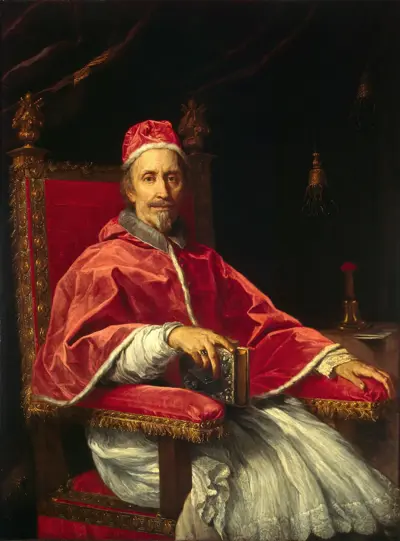
Pope Clement IX, born Giulio Rospigliosi, was Pope from 20 June 1667 to his death in 1669.
