Allen Dulles Quotes
We conclude that his [Patrice Lumumba’s] removal must be an urgent and prime objective of our covert action..
Lumumba was too socialistic for Dulles. He was not only removed from power by a covert CIA operation but the allies we selected to succeed him, then murdered him as they feared they had no one to match Lumumba’s popularity with the people.
Allen Welsh Dulles, 1893-1969, Director of the CIA, Secret Cable to the CIA Station in Leopoldville, Congo, August 1960
Sourced by: Eigen's Political and Historical Quotations

The United States had just ousted the popularly elected leader Patrice Lumumba {640611}, and backed Mobuto. Lumumba was an idealist who was not corrupt at all, but were not so sure about our new protégé. Sadly he turned out to be one of the worst kleptocrats of all time, and he stole with more United States money than we gave to many nations in toto. Many believe that one of the reasons, corruption of our “allied” leaders was so bad lies in the wording of this cable. Note that to the State Department writers there was “normal” corruption as opposed to excessive corruption. Once that view is taken there is a constant battle to determine whether each new act of corruption is “normal “ or not, and corruption is simply lessened by pushing back against the most abnormal schemes. These critics advocate a zero tolerance for corruption especially with United States AID money. The State Department has been ambivalent and have often used the corruption system to bribe leaders to obtain national objectives.

This and other quotations like {640611} and {640616} show that the State Department knew that Mobutu Sese Seko, the man we were backing in the Congo had many very undesirable characteristics for a dependable foreign ally and one who would be given control of billions of American money. Yet nothing was done and we continued to support him despite the kleptocracy and the instability that undermined his regime and the United States along with it.

The meeting was about the Congo. Patrice Lumumba was an extremely popular Congo leader who had just led the independence fight against Belgium and been elected Prime Minister and one of the few African leaders at the time who was not corrupt but he was a socialist. The mineral rich Katanga Province then seceded just a few weeks after Independence. Lumumba asked the UN. for supplies and trucks to allow him to keep the country together but the UN was bogged down in debate where the US thought that he might become, Russia then unilaterally offered the aid. Thinking that the Congo might become part of the Soviet Bloc, President Eisenhower called the meeting. Lumumba had not only claimed that he was not a communist but stated that Communism was just as bad as colonialism. A few weeks later the CIA engineered a coup of the Congo Military which had previously been organized and led by Colonial Belgium. The coup deposed Lumumba in favor of a corrupt incompetent Army Officer, Joseph Mobuto. Lumumba was arrested, and the UN Secretary General demanded that he be treated properly while Russia demanded that he be released as he could not have committed any crimes as he had been in office such a short time. While under "arrest" Lumumba was mysteriously murdered. The United States denied that America had anything to do with the murder. Johnson gave similar testimony under oath before the Senate Church Committee Investigating the Intelligence Agencies.


This covert project — PBSUCCESS — to destabilize Guatemala was exposed by the Guatemalan government. To minimize the embarrassment in the U. S., the PBSUCCESS CIA staff asked headquarters to fabricate sensational stories to keep newspapers and the fledgling TV news busy and distracted from covering the Guatemala story that the CIA was trying to destabilize the government in order to bring about regime change. The CIA was prohibited by law from doing this but the agency at that time ignored many laws. It is not known if the phony stories were actually planted at that time.
This was a time when line CIA officers would make very expansive legal decisions without necessarily consulting attorney’s and selecting specific targets for covert action without getting permission from the National Security Council and/or the President who was not even aware of some of the agency activities.

This coup has been the biggest trauma for the Iranian people in the last centuries. The blowback from it, has soured relationships between America and Iran for decades. Khamenei personally was traumatized by the coup and publicly refers to it quite frequently. Ironically, reasons and policy logic for the CIA orchestration of the coup are even today murky. The desires of the British may well have been the main reason. “Arrogance” is the term Khamenei uses to describe the British-American alliance and their propensity to try and shape the affairs of other nations.

It was unusual for anyone to call for the assassination of a foreign leader, but for a leading Christian cleric, this was a strange way of “turning the other cheek.”


The statement was made with respect to the possible overthrow of President Diem of South Vietnam, who was murdered anyway during the coup.

This was the first American initiative for the assassination of Fidel Castro.

Leftist Salvador Allende, despite covert CIA efforts to make him lose, was elected President. The CIA was then planning a coup to remove him from power. The CIA agents in Chile had kept the Ambassador in the dark, but he found out and cabled Secretary of State Henry Kissinger this warning. To Korry’s great surprise and disappointment Kissinger was in on the coup plans and he ordered Korry to stay out of it. Traditionally, the Ambassador is in charge of all U.S. Government Activity in the country, but in cases of covert operations, the Ambassador might or might not be in the loop. The coup d’etat took place, Allende committed suicide, and General August became the dictator of Chile and implemented a reign of terror for anyone who disagreed with his policies or programs. See {634506}.

To depose President Ngo Dinh Diem of South Vietnam Conein was one of the first American intelligence operatives in Vietnam. Diem was a creature of the Central Intelligence Agency. An anti-Communist Christian in a Buddhist county, the CIA engineered his rise to power, created his political party, provided him with cash to bribe other Vietnamese politicians, and paid for all the propaganda so he would “win” the Presidential elections. However, he abused the Buddhists, was thoroughly corrupt and ran a corrupt administration, but worst of all from the American point of view, he was unable to motivate the South Vietnamese population to fight the Communists. He reached the point where he was more of a liability, and the CIA, through Conein, engineered a coup d’etat to remove him from power and replace him with a President more to our liking. Though not planned that way, the South Vietnam military officers who we backed in the coup, then murdered Diem, who although ineffective and unsuccessful, had been a friend and ally of the United States. Even President Kennedy felt badly about the outcome. See {634539}.

Dulles was a master at manipulating presidents. Instead of just presenting his Bay of Pigs plan to Kennedy and assuring him of his belief in its likely success, Dulles brought in the comparison with Eisenhower, a great general with extensive foreign policy experience. If Ike would give the go ahead with a lesser success probability plan, then it showed the confidence that Eisenhower had in Dulles and the Central Intelligence Agency staff. If Kennedy were to kill the Bay of Pigs plan, then either he did not have the courage that Ike had or he was substituting his military judgment for Eisenhower’s. Kennedy approved the operation which was a terrible example of military planning. Kennedy, after the Bay of Pigs Debacle, never again had great confidence in the professional military and espionage. Many political scientists and historians credit this negative experience with the Bay of Pigs with giving Kennedy the confidence to not follow the recommendations of the leading military and intelligence staff when faced with the Cuban Missile Crises—even when members of the Joint Chief’s of Staff (Curtis LeMay was the most forceful) told him unequivocally that his failure to act more forcefully would likely weaken if not destroy the independence of the country. President Kennedy and his brother, Bobby, took a much more proactive role in the Missile Crises than they did in the Bay of Pigs.
This quotation would not be memorable but for the fact that one of the other “passengers” on that Central Intelligence Agency “train” was Saddam Hussein, who later became the dictator of Iraq and the enemy of the United States. This was a classic example of unintended consequences of covert operations. The Cia covertly put the Baath Party in power in Iran, and some years later, the Iraqi Baath Party became a major enemy of the United States.
See {634964} for the key Central Intelligence Agency’s Station Chief’s Description of some of these.

Johnson tasked Clark with finding out what the FBI knew of this story. The story was true. Worse, the CIA had hired members of the Mafia to do the assassination. (The Mafia resented Castro as he ended the Gambling Mecca that Cuba had been when his revolution succeeded. Before the Castro revolution, he Mafia got a “piece” of the profits from each Cuban casino for “protection.”) It might have been that the Kennedy Assassination was retaliation by Castro. However, the CIA withheld this from the Warren Commission and Robert Kennedy never revealed it even though he was a member of the Commission and the Commission had security clearance. See {637465}.

See {637464} for the trigger for the FBI to write this report. It was the report that verified that the CIA had hired the Mafia to assassinate Fidel Castro which President Johnson had heard but the CIA never revealed it to Johnson or the Warren Commission investigations JFK’s assassination. The full document was kept secret and was not yet declassified in 2014 when this quotation was entered in the collection.
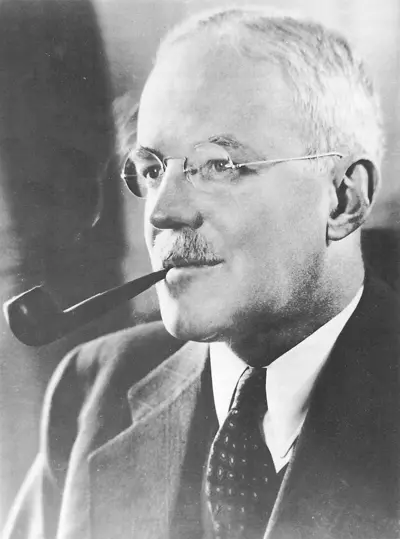
- Born: April 7, 1893
- Died: January 29, 1969
- Nationality: American
- Profession: CIA Director
Allen Welsh Dulles was the first civilian Director of Central Intelligence (DCI), and its longest-serving director to date. As head of the Central Intelligence Agency (CIA) during the early Cold War, he oversaw the 1953 Iranian coup d'état, the 1954 Guatemalan coup d'état, the Lockheed U-2 aircraft program, the Project MKUltra mind control program and the Bay of Pigs Invasion. He was fired by John F. Kennedy over the latter fiasco.
