Miguel Ydigoras Fuentes Quotes
A former executive of the United Fruit Company, now retired, Mr. Walter Turnbull, came to see me with two gentlemen whom he introduced as agents of the CIA. They said I was a popular figure in Guatemala and that they wanted to lend their assistance to overthrow Arbenz… Among other things, I was to promise to favor the United Fruit Company and the International Railways of Central America; to destroy the railroad workers union…
Miguel Ydigoras Fuentes, 1895-1982, President of Guatemala, My War with Communism
Sourced by: Eigen's Political and Historical Quotations

This coup has been the biggest trauma for the Iranian people in the last centuries. The blowback from it, has soured relationships between America and Iran for decades. Khamenei personally was traumatized by the coup and publicly refers to it quite frequently. Ironically, reasons and policy logic for the CIA orchestration of the coup are even today murky. The desires of the British may well have been the main reason. “Arrogance” is the term Khamenei uses to describe the British-American alliance and their propensity to try and shape the affairs of other nations.

The “help” was a covert CIA 1954 operation that overthrew the government


John E. Puerifoy, the American ambassador to Guatemala

Lumumba was too socialistic for Dulles. He was not only removed from power by a covert CIA operation but the allies we selected to succeed him, then murdered him as they feared they had no one to match Lumumba’s popularity with the people.
This covert project — PBSUCCESS — to destabilize Guatemala was exposed by the Guatemalan government. To minimize the embarrassment in the U. S., the PBSUCCESS CIA staff asked headquarters to fabricate sensational stories to keep newspapers and the fledgling TV news busy and distracted from covering the Guatemala story that the CIA was trying to destabilize the government in order to bring about regime change. The CIA was prohibited by law from doing this but the agency at that time ignored many laws. It is not known if the phony stories were actually planted at that time.

The Lloyd George government was using the military to cross the picket line of a national miners’ strike.

The meeting was about the Congo. Patrice Lumumba was an extremely popular Congo leader who had just led the independence fight against Belgium and been elected Prime Minister and one of the few African leaders at the time who was not corrupt but he was a socialist. The mineral rich Katanga Province then seceded just a few weeks after Independence. Lumumba asked the UN. for supplies and trucks to allow him to keep the country together but the UN was bogged down in debate where the US thought that he might become, Russia then unilaterally offered the aid. Thinking that the Congo might become part of the Soviet Bloc, President Eisenhower called the meeting. Lumumba had not only claimed that he was not a communist but stated that Communism was just as bad as colonialism. A few weeks later the CIA engineered a coup of the Congo Military which had previously been organized and led by Colonial Belgium. The coup deposed Lumumba in favor of a corrupt incompetent Army Officer, Joseph Mobuto. Lumumba was arrested, and the UN Secretary General demanded that he be treated properly while Russia demanded that he be released as he could not have committed any crimes as he had been in office such a short time. While under "arrest" Lumumba was mysteriously murdered. The United States denied that America had anything to do with the murder. Johnson gave similar testimony under oath before the Senate Church Committee Investigating the Intelligence Agencies.

Dulles was a master at manipulating presidents. Instead of just presenting his Bay of Pigs plan to Kennedy and assuring him of his belief in its likely success, Dulles brought in the comparison with Eisenhower, a great general with extensive foreign policy experience. If Ike would give the go ahead with a lesser success probability plan, then it showed the confidence that Eisenhower had in Dulles and the Central Intelligence Agency staff. If Kennedy were to kill the Bay of Pigs plan, then either he did not have the courage that Ike had or he was substituting his military judgment for Eisenhower’s. Kennedy approved the operation which was a terrible example of military planning. Kennedy, after the Bay of Pigs Debacle, never again had great confidence in the professional military and espionage. Many political scientists and historians credit this negative experience with the Bay of Pigs with giving Kennedy the confidence to not follow the recommendations of the leading military and intelligence staff when faced with the Cuban Missile Crises—even when members of the Joint Chief’s of Staff (Curtis LeMay was the most forceful) told him unequivocally that his failure to act more forcefully would likely weaken if not destroy the independence of the country. President Kennedy and his brother, Bobby, took a much more proactive role in the Missile Crises than they did in the Bay of Pigs.


Even the CIA and the other U. S. Intelligence missed predicting the Arab Spring, but so did the intelligence services of all our allies, Russia, China and even Israel which usually has the best intelligence in the Middle East. One of the reasons he argues is that media and technology played such an important role in facilitating the Arab Spring and the intelligence agencies do not really understand the new media world. The people who do some argue are too young to ever be in enough key positions in these agencies to have much influence.

With the successful Chinese Communist Revolution, the Nationalists were driven off the mainland of China and occupied the island of Formosa (Taiwan) and had a small garrison of soldier on two tiny islands off the Chinese Coast, Quemoy and Matsu. The communist Chinese government wanted control of all three of the Nationalist held islands. It became a campaign issue or whether or not the United States should go to war to protect the two tiny islands from the communists even though there were no civilians on them and they had virtually no value other than symbolic. Nixon, took the position that the Chinese Communists must be stopped as they had world conquest as their objective. Philosophically, many Communists of the time, following Marxist theory, actually believed that Capitalism would crumble and communism would take its place. In that sense many felt that the world would be communist. China, as we now know, was more concerned with counterrevolution by the nationalists, expansionism and growth of Vietnam (her ancient enemy), the rise of Japan, border wars with India, and constant threats from Russia and China had no military plans for world conquest.

20th century Africa and South America were particularly good examples.

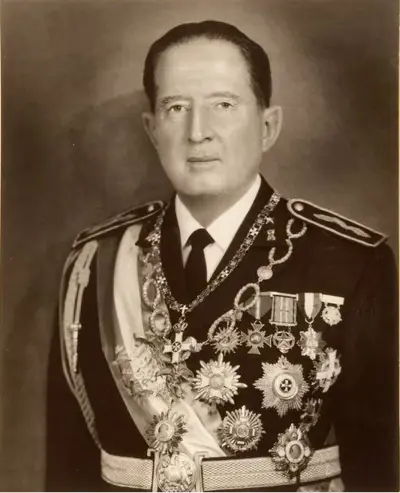
General José Miguel Ramón Ydígoras Fuentes was the conservative President of Guatemala from 1958 to March 1963. He was also the main challenger to Jacobo Árbenz during the 1950 presidential election. He had previously served as the governor of the province of San Marcos.
