Pius XII Quotes
We, armed only with the word of Truth and standing above all public disputes and passions, speak to you in the name of God …
The Pope appealed as a neutral force. In reality however, the Vatican had much at stake if war broke out. There were many German Catholics, some of whom might have been victimized by the Nazis and others who were Nazis. The independence of the Vatican itself was at stake as Italy had gone fascist. The war put the Pope in a very difficult political position which some argued colored his moral judgment and public statements. Most documents of the time are sealed by the Vatican.
Pius XII, 1876-1958, [Eugenio Pacelli], Pope, Appeal just before the outbreak of WWII in Europe
Sourced by: Eigen's Political and Historical Quotations


Hizb ut-Tahrir is a “worldwide Islamic political party.” It is banned as a terrorist, violence provoking institution in most of the Muslim countries and many nations in Europe.

Unfortunately, the prime minister turned out to be very accurate in his predictions. The Second World War functioned just as he said.

This quotation is surprising in that Mrs. Roosevelt was a leading liberal and one of the leading advocates for peace. This quotation might have been authored by a right wing conservative of the early 21st century.

At first glance, the reader might think that this quotation in a leading university newspaper was from the Vietnam War era. However, it was argument against U. S. involvement in World War II. There was a very negative reaction to Wilson’s visions and claims for the First World War which never did come to pass that stuck with many.

Kerry, a decorated, former Navy officer, was then a spokesperson for Vietnam Veterans Against the War.


Theodore Roosevelt was the Presidential nominee. Johnson was a leader of some members of Congress some of whom were extreme isolationists and some of whom were Nazi sympathizers and Hitler admirers. When the Japanese attacked Pearl Harbor later that year, Germany, fulfilling its treaty with Japan, declared war on America, Johnson’s group no longer mattered. Before WWII most Republicans were opposed to Defense Spending and accused the Democrats of being war hawks. After WWII, they flip flopped and became more hawkish than the Democrats who they accused of being soft on defense for years thereafter. See {631380} for President Roosevelt’s different view.

At this point, the horrors of the German concentration death camps were generally known by the world press. This quotation shows the denial that the Irish Free State was in about the German Nazi atrocities. The 6-county Nationalsits were the Irish counties in Northern Ireland that did not join the Irish Free State and so far as the Catholic Irish were concerned, the Catholics of Northern Ireland were a persecuted minority undergoing oppression and that was not they believed morally different from the murders of millions of Jews, Gypsies and handicapped people in Europe. If the Free State Irish publicly admitted the difference, they would morally have had to join the allies and De Valera was totally opposed to that. Over 70,000 Irishmen and women rejected the moral stand of their government, and volunteered for the British Army to the great distress of the Free State leaders like De Valera. See {639722} for his personal denial of reality.

This was Ford in the middle of his career. As he got older, he changed radically. He was later one of the biggest supporters and admirers of Adolf Hitler and his aggressive militarism.


England was the only power opposing Hitler led Nazi Germany, and they were being weakened daily by their unsupported military efforts.


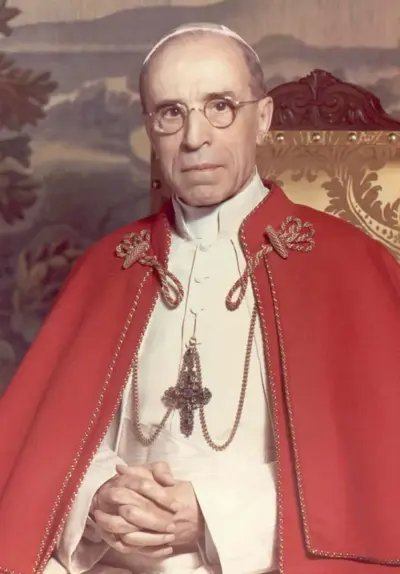
Eugenio Maria Giuseppe Giovanni Pacelli was born on 2 March 1876 in Rome into a family of intense Catholic piety with a history of ties to the papacy (the "Black Nobility"). His parents were Filippo Pacelli (1837–1916) and Virginia (née Graziosi) Pacelli (1844–1920). His grandfather, Marcantonio Pacelli, had been Under-Secretary in the Papal Ministry of Finances and then Secretary of the Interior under Pope Pius IX from 1851 to 1870 and helped found the Vatican's newspaper, L'Osservatore Romano in 1861. His cousin, Ernesto Pacelli, was a key financial advisor to Pope Leo XIII; his father, Filippo Pacelli, a Franciscan tertiary, was the dean of the Roman Rota; and his brother, Francesco Pacelli, became a lay canon lawyer and the legal advisor to Pope Pius XI, in which role he negotiated the Lateran Treaty in 1929 with Benito Mussolini, bringing an end to the Roman Question.
