Pius XII Quotes
It is by force of reason and not by force of arms that Justice makes progress; and empires which are not founded on Justice are not blessed by God. Statesmanship emancipated from morality betrays those very ones who would have it so.
Pius XII, 1876-1958, [Eugenio Pacelli], Pope, Appeal just before the outbreak of WWII in Europe
Sourced by: Eigen's Political and Historical Quotations

The Second World War placed the Mormons in a dilemma whereby they had adherents on both sides of the conflict as was the case with the Catholic Church. Positions the church took on the behavior of the belligerents could cost the church its position and influence especially in Germany. The Catholic Church was more careful of offending the Nazis and did not speak out much against the worst of the atrocities. The Mormons in contrast saw the Nazis as the agents of Satan determined to exterminate the Jews so that they could not return to Israel which under Mormon (and some Protestant) prophesy was necessary to occur before the Second Coming.


In the American democracy the tradeoff between military activity and respect for human rights has always been an issue.

The Prime Minister was viewing films of the effects on cities of Allied bombing of Germany.


War between England and Germany had just commenced.

His appeal was also in the name of concurring heads of state of Finland, Holland, Denmark, Norway, Luxemburg, and Sweden.

The Pope appealed as a neutral force. In reality however, the Vatican had much at stake if war broke out. There were many German Catholics, some of whom might have been victimized by the Nazis and others who were Nazis. The independence of the Vatican itself was at stake as Italy had gone fascist. The war put the Pope in a very difficult political position which some argued colored his moral judgment and public statements. Most documents of the time are sealed by the Vatican.

He was announcing war with Germany.


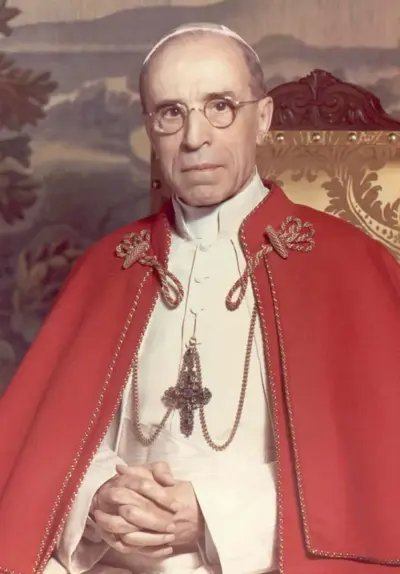
Eugenio Maria Giuseppe Giovanni Pacelli was born on 2 March 1876 in Rome into a family of intense Catholic piety with a history of ties to the papacy (the "Black Nobility"). His parents were Filippo Pacelli (1837–1916) and Virginia (née Graziosi) Pacelli (1844–1920). His grandfather, Marcantonio Pacelli, had been Under-Secretary in the Papal Ministry of Finances and then Secretary of the Interior under Pope Pius IX from 1851 to 1870 and helped found the Vatican's newspaper, L'Osservatore Romano in 1861. His cousin, Ernesto Pacelli, was a key financial advisor to Pope Leo XIII; his father, Filippo Pacelli, a Franciscan tertiary, was the dean of the Roman Rota; and his brother, Francesco Pacelli, became a lay canon lawyer and the legal advisor to Pope Pius XI, in which role he negotiated the Lateran Treaty in 1929 with Benito Mussolini, bringing an end to the Roman Question.
