Adolf Hitler Quotes
As Fuehrer of the German people and Chancellor of the Reich, I can thank God at this moment that he has so wonderfully blessed us in our hard struggle for what is our right, and beg Him that we and all other nations may find the right way, so that not only the German people but all Europe may once more be granted the blessing of peace.
Hitler, Adolf. The Speeches of Adolf Hitler, April 1922-August 1939, vol. 2. Translated by Norman H. Baynes, Oxford University Press, 1942, p. 1665.


1st Earl Baldwin of Bewdley. Chamberlain was about to leave for the Munich Conference where his appeasement emboldened Hitler and the Germans and dashed all hope of peace. Baldwin was out of office, but his support of the Munich appeasement changed his image from that of a popular statesman, to a craven appeaser. See {626930} for Churchill’s view of Baldwin.


England was the only power opposing Hitler led Nazi Germany, and they were being weakened daily by their unsupported military efforts.

Hopkins was a social worker with no military of political experience. But the President trusted him implicitly. Most American military officers and Ambassador to England Joseph P. Kennedy, a Nazi sympathizer & father of JFK, believed that England could not stand up to Hitler. Any military aid we gave England would fall into the hands of the Germans. Everyone was shocked when Roosevelt sent Hopkins to England to make a military recommendation. To impress Hopkins with something he thought Hopkins would be interested in, Churchill led a tour of workers cottages built by the government. Hopkins surprised Churchill and his aids who would never forget this statement & then asked to see the military facilities. Hopkins distressed the American military by recommending that Britain could hold out against invasion if they received military aid. Despite the contrary military advice, FDR accepted Hopkins’ recommendations, and the rest is history. He had been right and much of the military wrong.

The attack on the World Trade Towers and our military reaction to that could not fairly be blamed on Bush. However, the Iraq War was certainly a policy choice he made. And he also made the decision to cut taxes (mostly for the rich) on the assumption that this would stimulate the economy and produce even more taxes. It did not. And also on Bush’s policy responsibility was his decision not to raise taxes to pay for a war. This had never been done in American history. And Bush was fighting two wars. In addition when he took office Bill Clinton had balanced the budget and left a substantial surplus. Instead of using the surplus to pay for his other policy decisions, he spent it.


This is an important quotation because it shows that Franco was not only a Fascist but one who supported and approved of Hitler personally and his criminal programs. Most Spaniards have thereafter regretted that the Spanish Dictator could take such a murderous and inhumane position on behalf of the Spanish people. Franco was supported only by some of the very wealthy, part of the military and the Catholic Church leadership. The latter also makes this quotation important, in that it is very doubtful that the Spanish church leaders would support Hitler if the Pope and the Vatican were opposed to Hitler and the Nazis. Yet some Vatican representatives have maintained that the Pope was definitely opposed to Hitler and Nazism, but the evidence for this is not strong. This quotation tends to lend more credence to the Papal critics.

She had gone to Europe where the 2nd World War was raging.

The Prime Minister, Neville Chamberlain, preceded him with the announcement of declaration of war against Germany, but it was left up to the Foreign Minister to explain the implications. This was the first time in history that a nation had used radio to communicate such momentous events to its population.


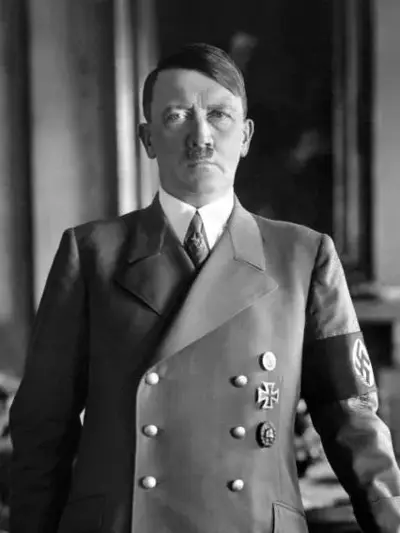
Adolf Hitler was an Austrian-born German politician who was the dictator of Germany from 1933 to 1945. He rose to power as the leader of the Nazi Party, becoming Chancellor in 1933 and then assuming the title of Führer und Reichskanzler in 1934. During his dictatorship from 1933 to 1945, he initiated World War II in Europe by invading Poland on 1 September 1939. He was closely involved in military operations throughout the war and was central to the perpetration of the Holocaust, the genocide of about 6 million Jews and millions of other victims.
