Adolf Hitler Quotes
We are quite prepared to make an alliance with the devil himself.
As the United States showed increasing interest in joining the European theatre, Hitler turned to Japan even though an alliance with Japan seemed to betray Nazi nationalist/racist doctrine.
Adolf Hitler, 1889-1945, Fuhrer of the Third German Reich, Quoted in Rich, Great Power Diplomacy
Sourced by: Eigen's Political and Historical Quotations

This was written after the war when Germany was divided into four parts, later to become East and West Germany. German historical and cultural aggression and militarism, most policy makers feared, would cause more war if Germany was unified and allowed to become a strong state. NATO and The European Union became the federations that Kennan was seeking. And Germany underwent a radical cultural and political change.

Responding to a question of how he, as a black man, could talk with the president of South Africa:


Turkey had just defeated a Greek invading army with bitter atrocities on both sides. The two countries were bitter enemies. His colleagues thought Ataturk had lost is sense of reality to even suggest such a thing. 50 years later Greece and Turkey were both in NATO.


Machiavelli was lying on his deathbed and was visited by the local Bishop who asked him, “Do you now forsake the Devil?”


This statement is perhaps the greatest and most eloquent description of the United States exceptionalism and its behavior in WWII. Such a statement could only come from a non-American.

The Iroquois had a very successful confederacy of 6 tribes in a relatively democratic government with a written constitution. They dominated the Eastern part of North America for years. The were able to maintain a permanent unity with a unified and decentralized combination of government—much like the United States would become. At the time of this advice, each American colony was a government unto itself. The three Iroquois Indian delegates were Canassatego, Tachanoontia, and Gachradodow.

This speech was given in the early days of WWII when it was far from clear that we would win.

This is an important quotation because it shows that Franco was not only a Fascist but one who supported and approved of Hitler personally and his criminal programs. Most Spaniards have thereafter regretted that the Spanish Dictator could take such a murderous and inhumane position on behalf of the Spanish people. Franco was supported only by some of the very wealthy, part of the military and the Catholic Church leadership. The latter also makes this quotation important, in that it is very doubtful that the Spanish church leaders would support Hitler if the Pope and the Vatican were opposed to Hitler and the Nazis. Yet some Vatican representatives have maintained that the Pope was definitely opposed to Hitler and Nazism, but the evidence for this is not strong. This quotation tends to lend more credence to the Papal critics.

Gehlen’s war crimes and knowledge thereof were overlooked setting a precedent for even allowing German and Japanese major war criminals into the United States. In those days, most men of substance belonged to one or more private clubs which was a important element of their social and professional lives. People of unsavory character were not welcome at such clubs.


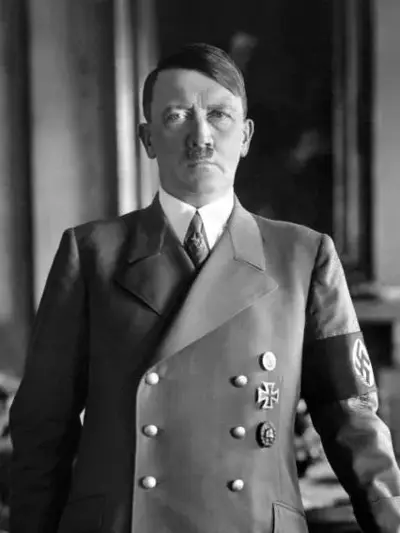
Adolf Hitler was an Austrian-born German politician who was the dictator of Germany from 1933 to 1945. He rose to power as the leader of the Nazi Party, becoming Chancellor in 1933 and then assuming the title of Führer und Reichskanzler in 1934. During his dictatorship from 1933 to 1945, he initiated World War II in Europe by invading Poland on 1 September 1939. He was closely involved in military operations throughout the war and was central to the perpetration of the Holocaust, the genocide of about 6 million Jews and millions of other victims.
