Alan Greenspan Quotes
Very low probability events occur very rarely, but sometimes they do happen.
Alan Greenspan, Chairman, Federal Reserve Board, House Testimony, July 25, 2000
Sourced by: Eigen's Political and Historical Quotations

Technically, the probability has never changed. However, most probabilities are in relation to a specific event or time. A levee may have only a 1% probably of failing in a hurricane but if there are 10 hurricanes a year, the probability that the levee will fail at least once in 30 years is about 50%.


Politicians, like many other people, often confuse correlation with causality as few have studied or understand the mathematics of probability.


See {630694} for a later, more specific instance where Hand’s principle was required operationally.


Politicians and public administrators have been aware of unintended consequences for a long time.


There is a great tendency in politics and government operations to get extremely precise numbers because political opponents will always attack all numbers that do not support their positions. The result is that typically, so much time and money goes into trying to get precision, that by the time the numbers are good enough the opportunity to make the right policy decision will have passed. Much information that bears on an issue is never used because it is not precise enough while the precise information is not particularly relevant. See {619763} for a similar related quote.


He is absolutely right, but unfortunately made this statement several years after he served as the Fed Chairman. He never made a statement like this when he and his colleagues made their policies based on their economic forecasting. Central bankers have generally felt that one of their jobs was to give the people confidence in the nation’s banking system and economy and the admission that much policy making was based on “coin toss” forecasting.

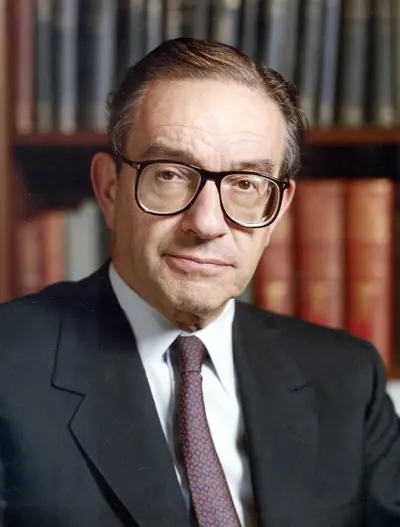
Alan Greenspan is an American economist who served five terms as the 13th Chair of the Federal Reserve of the United States from 1987 to 2006. He works as a private adviser and provides consulting for firms through his company, Greenspan Associates LLC. First appointed Federal Reserve chairman by President Ronald Reagan in August 1987, he was reappointed at successive four-year intervals until retiring on January 31, 2006, after the second-longest tenure in the position (behind William McChesney Martin).
