Paul Robeson Quotes
Vast quantities of U.S. bombers, tanks and guns have been sent against Ho Chi Minh and his freedom-fighters; and now we are told that soon it will be 'advisable' to send America GI's into Indo-China in order that the tin, rubber and tungsten of Southeast Asia be kept by the "free world"-meaning white Imperialism.
Robeson, Paul. "Ho Chi Minh is the Toussaint L'Ouverture of Indo-China." Paul Robeson Speaks: Writings, Speeches, Interviews 1918-1974, edited by Philip S. Foner, Brunner/Mazel, 1978, p. 376.


Most socialists in American and elsewhere initially supported the United States policy of intervention in the Vietnamese civil war. While they disapproved of much of the general economic policy, the Russian, Chinese and other Communist trampling on human rights seemed like a worse alternative.

Chomsky was not asserting this statement as the truth. He was making the statement assuming that the absurdity of it would be clear to the listener and they would also realize that was what the then government policy was. North Vietnamese had infiltrated the South and had much support in many of the South Vietnamese villages. When the U. S. bombed the North Vietnamese—and the Vietnamese inhabitants—of those villages, the intention was indeed to help the South Vietnamese. If Chomsky were a politician running for office, his opponent might well have taken this quote and used it to “prove” that Chomsky supported the American effort in the Vietnam War when he was a vehement opponent.


The occasion was the visit to Washington of French Minister M. Jean Letourneau. The French were fighting the communists in Vietnam and the U. S., not yet in the fight, promised material and political aid, but no military participation. It was almost a decade later that America sent its first military personnel to Vietnam. The West was persuaded that the French could handle the situation. When they were defeated, America and Britain assumed that it was the notorious military incompetence of the French that accounted for the situation rather than the competence and commitment of the Vietnamese Communists and their support of the majority of the people.

After the French were driven out, Vietnam was supposed to have a national election to choose a government but the people of Vietnam were deeply split between those supporting the Communists and Ho Chi Min (who had led the campaign to oust the French from their colony) on one side and Vietnamese who were more Westernized and favored a democracy. Vietnam was mostly Buddhist but most of the Western oriented leadership of the Democracy advocates were Christians. They wanted to delay the election to give them a chance to organize to catch up with the communists at political organization. Ho Chi Min and the Communists already do facto controlled the North of Vietnam and decided to use force against the Western oriented forces whose military was much smaller than the Communists who had ejected the French. The United States provided financial aid and supplied weapons and Central Intelligence Agency assistance to the South Vietnam forces who were afraid of being overrun by the Communists headquartered in the North. Taylor’s mission was to go to Vietnam, assess the situation and make recommendations to President Kennedy.

Most Americans had not then realized that American troops had gotten involved in the Vietnamese Civil War. For some this was shocking. Kennedy helped his brother, President Kennedy, arrange for a coup to replace President Ngo Dinh Diem in which the man we pledged to “stand by” was murdered. He turned out to be thoroughly corrupt, and had little if any more respect for democracy and human rights than the North Vietnamese leadership did. Nonetheless we broke a pledge to an ally. This and similar promises that are not kept complicates American diplomacy as there is rarely complete trust in the pledges of American officials.


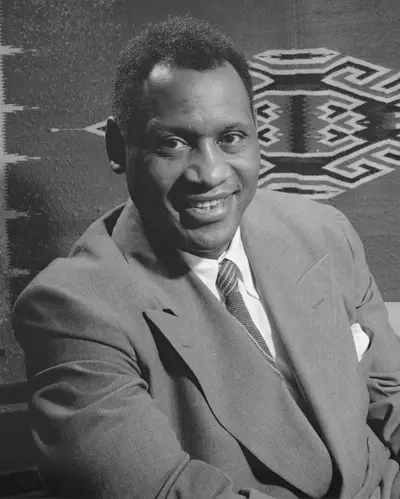
Paul Leroy Robeson was an American bass baritone concert artist and stage and film actor who became famous both for his cultural accomplishments and for his political activism. Educated at Rutgers College and Columbia University, he was a star athlete in his youth. He also studied Swahili and phonetics at the School of Oriental and African Studies in London in 1934. His political activities began with his involvement with unemployed workers and anti-imperialist students whom he met in Britain and continued with support for the Republican cause in the Spanish Civil War and his opposition to fascism. In the United States he became active in the Civil Rights Movement and other social justice campaigns. His sympathies for the Soviet Union and for communism, and his criticism of the United States government and its foreign policies, caused him to be blacklisted during the McCarthy era.
