Joseph Story Quotes
Upon subjects of government, it has always appeared to me that metaphysical refinements are out of place. A Constitution of government is addressed to the common sense of the people; and never was designed for trials of logical skill or visionary speculation.
Joseph Story, 1779-1845, U. S. Supreme Court Justice, Quoted in Raoul Berger, Government by Judiciary: The Transformation of the Fourteenth Amendment, 1977
Sourced by: Eigen's Political and Historical Quotations


He was commenting on the Constitution that had come out of the 1789 Constitutional Convention in Philadelphia and did not yet have the Bill of Rights.


When asked for his position on abortion, candidate Bush answered:. Nine years later, President Bush proposed a constitutional amendment to overturn the Supreme Court's ruling on flag desecration.


This concept of balance of power and the equal role of the judiciary is actually quite rare. Even in Parliamentary democracies the parliament can override any court interpretation. In England, the upper legislative house, the House of Lords, actually serves as the nation’s highest or supreme court. And these “Law Lords” can override all regular judicial bodies.


Franklin wrote the speech, but was too old and ill to deliver it personally. James Wilson of Pennsylvania did the honors for him.

In a 1949 dissenting opinion in Terminiello v. Chicago Jackson claimed the majority view would “convert the Bill of Rights into a suicide pact.”


The conservative Senator was very distrustful of the constitutional amendment process itself after a both prohibition and women's suffrage amendments had passed. Wadsworth and his supporters feared Constitutional amendments passed by Congress and the State legislatures without any direct approval of the people.


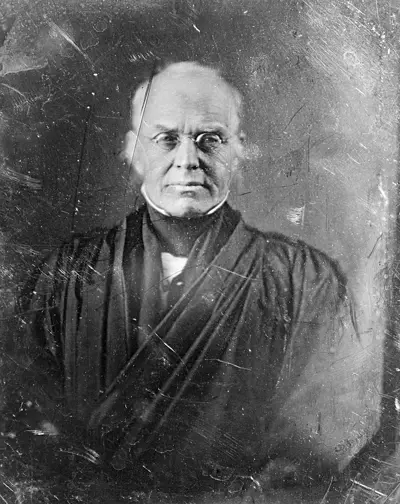
Joseph Story was an American lawyer and jurist who served on the Supreme Court of the United States from 1812 to 1845, during the Marshall Court and early-Taney Court eras. He is most remembered for his opinions in Martin v. Hunter's Lessee and The Amistad case, and especially for his magisterial Commentaries on the Constitution of the United States, first published in 1833. Dominating the field in the 19th century, this work is a cornerstone of early American jurisprudence. It is the second comprehensive treatise on the provisions of the U.S. Constitution and remains a critical source of historical information about the forming of the American republic and the early struggles to define its law.
