Haile Selassie Quotes
Until the philosophy which holds one race superior and another inferior is finally and permanently discredited and abandoned; that until there is no longer any first-class and second-class citizens of any nation; that until the color of a man's skin is of no more significance than the color of his eyes; that until the basic human rights are equally guaranteed to all, without regard to race -- until that day, the dreams of lasting peace and world citizenship and the rule of international morality will remain but a fleeting illusion, to be pursued but never attained
Haile Selassie, 1891-1975, Ethiopian Emperor, Speech, California, February 28, 1968
Sourced by: Eigen's Political and Historical Quotations


Essentially this quotation led to a major war and yhrn a later war of independence for Blacks in South Africa. Porter was the Attorney General of the English Cape Colony in South Africa. In an early legal ruling he observed that South Aftica was a colony under English law which did not permit discrimination on the basis of skin color. However, there was a large proportion of Afrikaners—whites of Dutch Ancestry who were culturally strong racists and saw the Blacks as a combination of potential rivals for land and a potential subjegated labor force. They tended to leave the Capetown area and English law. The Afrikaners ended up in a major war—the Boer War—against the English and although the English won the war, the Afrikaners won the political peace and ended up dominating South Africa and imposing apartheid. The Blacks of the mid 20th century had if nothing else, the 100 year old legal and moral precendent from Porter’s opinion which justified the ANC leading the attack on apartheid which finally succeeded. It took 100 years and millions of suffering and dying people but finally, the law of South Africa was as Porter had stated it, and since the Blacks were in the great majority, the Whites became the minority, but due to the ANC leadership of men like Nelson Mandella, the Blacks did not seek revenge on the Afrikaner whites although there was resentlent for generations.

Humphrey was the Mayor of Minneapolis then.

Many fighters for civil rights split from the majority of the Black leadership over racial preferences for affirmative action.


The issue of slavery which had been suppressed in Congress for the first decades of the nation broke out when Missouri statehood was considered. By previous agreement, slavery was not even discussed in Congress but the time period elapsed. Tallmadge not only proposed that no more slaves could come into Missouri {613176} but most shocking to the Southerners was that every person born in the new state would be free at the age of 25. In a generation, there would be no more slavery in Missouri and there would be no economic compensation for slave owners at all. The House of Representatives accepted the amendment, but it failed in the Senate. At that time, Senators were not elected by voters but were appointed by the state legislators and the Southern slave states had a disproportionate share of the senate from a population point of view. But what this quotation shows clearly that a majority of the country in 1819 were opposed to slavery and were willing to end it without compensation.

Douglas was appealing to the racist crowd in Galesburg by showing that Lincoln actually believed in Racial Equality. This technique was used be racist politicians—since then and in a few places of the South even into the 21st century.

This is a particularly memorable quotation for several reasons. First the address was given by a young senior student who would later be a member of Congress, a effective abolitionist, and the author of various pieces of legislation that vexed the South. What is even more memorable is that the oration was given at an Ivy League College Official Graduation. The Ivy league schools, despite their reputation for intellectual freedom, generally were very adverse to any discussion about the slavery issue as it would cause too much passionate contention. See {621346} for an example at Harvard. In addition, Brown University was in Providence RI, where the economy depended in substantial part on slavery. The Co-Founder of Brown was himself a slave trader {622028}. This was one of the early American anti-slavery orations.


The reason this quotation is important, it was the first time in American history that a President had tied racial discrimination to morality. Before that other Presidents had argued against segregation on pragmatic grounds or on legal, Constitutional grounds. Kennedy’s private moral declaration had a huge impact on Black leaders throughout the country who heard about it by word of mouth. That statement forged a bond between JFK and Blacks while most whites did not see anything striking in the statement.

While this was a type of “Equal Rights Amendment”, It emphasized dignity rather than operations. For example, adultery was made a crime if committed by a woman (not for a man), And women could be dismissed from a job, simply because they were pregnant. And unusual aspect of this quotation is the fact that it applies to equality of dignity of Social status. In America we have this as an unwritten concept of fairness and egalitarianism, but it is not followed very much and certainly not guaranteed by our Constitution.
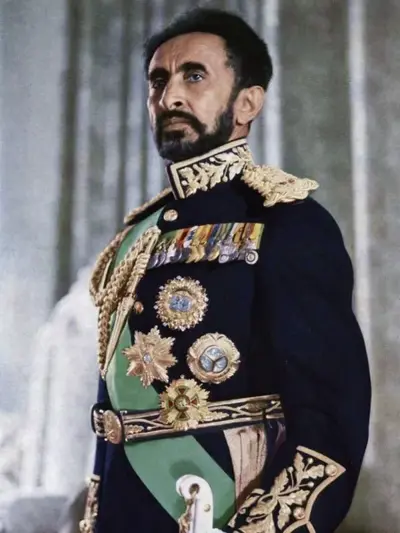
Haile Selassie I was the Emperor of Ethiopia from 1930 to 1974. Prior to his coronation, he had been the Regent Plenipotentiary of Ethiopia from 1916. He is a defining figure in modern Ethiopian history. He was a member of the Solomonic dynasty who traced his lineage to Emperor Menelik I.
