John Adams Quotes
Universal and perpetual peace appear to me no more or less than everlasting passive obedience and non-resistance. The human flock would be fleeced or butchered by one or a few.
John Adams, 1735-1826, 2nd President of the United States (Federalist), Rejecting an honorary membership in a peace society, Quoted in Edson Whitney, American Peace Society: A Centennial History, 1928
Sourced by: Eigen's Political and Historical Quotations


Theodore Roosevelt was the Presidential nominee. Johnson was a leader of some members of Congress some of whom were extreme isolationists and some of whom were Nazi sympathizers and Hitler admirers. When the Japanese attacked Pearl Harbor later that year, Germany, fulfilling its treaty with Japan, declared war on America, Johnson’s group no longer mattered. Before WWII most Republicans were opposed to Defense Spending and accused the Democrats of being war hawks. After WWII, they flip flopped and became more hawkish than the Democrats who they accused of being soft on defense for years thereafter. See {631380} for President Roosevelt’s different view.


Inscription on the outside front wall of the United Nations, New York City


In 1946 the maneuvering and posturing of the United Nations delegates led him to remark: Viscount Cecil of Chelwood


1st Baronet Hart. The Customs Duty was a major revenue source for governments of the day. China, had such a history and culture of corruption, especially around customs, that the Empress Cixi, to the distress of many of her own people, appointed Hart to oversee the entire customs operations. The yield amazed all, and opposition to Hart evaporated except from the officials who could no longer profit as before. Hart served in this position for 47 years.


At that time the Israelis had been rebuffed after offing several major peace proposals and most were convinced that the Palestinians were so fractionated that no one would dare sign a peace even giving Palestinians their own state and sharing Jerusalem as the capital. So they just organized around security needs and walling Israel off from terrorist attacks while maintaining the occupation until something radially changes amongst the Palestinians. The Palestinians and the other Arabs did not want to negotiate either as they felt so weak that they believed they could never get decent terms, and they hoped for some military or terrorist victories where the Israelis would make large concessions to a strong opponent. At the same time there were a few ultra-orthodox Jews who did not want a peace and wanted to do what conquering nations had done throughout history—annex more conquered territory. There were a number of Arab groups, in addition to some Palestinians who did not want a peace at all, as for them there was no satisfactory solution so long as there was a Jewish state in their midst. See {632822} for more on the Israeli attitude then.

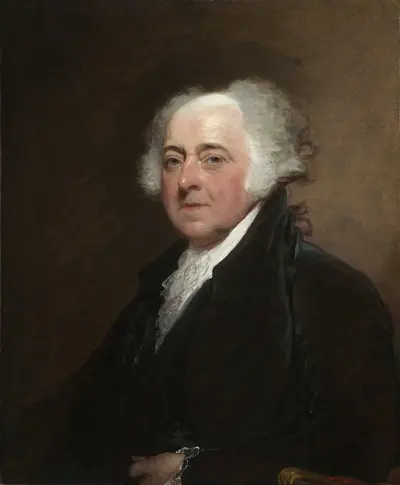
John Adams Jr. was an American statesman, attorney, diplomat, writer, and Founding Father who served as the second president of the United States from 1797 to 1801. Before his presidency, he was a leader of the American Revolution that achieved independence from Great Britain, and he served as the first vice president of the United States. Adams was a dedicated diarist and regularly corresponded with many important figures in early American history, including his wife and adviser Abigail Adams and Thomas Jefferson.
