Karl Marx Quotes
Under private property, each tries to establish over the other an alien power, so as thereby to find satisfaction of his own selfish need. The increase in the quantity of objects is therefore accompanied by an extension of the realm of the alien powers to which man is subjected, and every new product represents a new potentiality of mutual swindling and mutual plundering.
Marx, Karl. Economic and Philosophic Manuscripts of 1844. Karl Marx, Frederick Engels: Collected Works, Vol. 3. International Publishers, 1975, p. 306.


In 1877 Wasburn was dropped from the List of Ministers by the Unitarian Church. He had become quite atheistic.


In May of 1886 police had killed some strikers for an 8 hour work day at the McCormick Plant in Chicago. A left wing newspaper called a rally using the word “revenge.” (See {43614}.) The next day, at the rally, someone threw a dynamite bomb killing several police who in turn wounded and killed many of the protestors. 31 people were indicted for the “Haymarket Bombing,” 8 were tried, and 7 were convicted and sentenced to death including Spies. There was however, no evidence linking any of the defendants with the bombing, only evidence linking them with left wing, anarchist positions and writings.


Tolstoy saw this as a much more general phenomenon than classic cases where the English dominated India. He not only included ethnic minorities (like the Chinese who dominate the economy of the Philippines or the Shiite-Sunni dominance battles in the Middle East, but he included a classic business situation where the minority (the wealthy owners and bosses) dominate and control the majority (the workers).


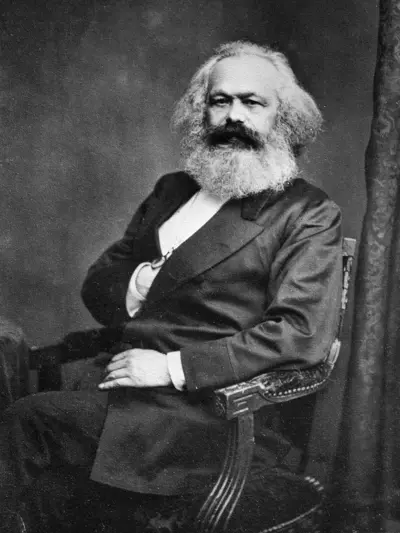
Karl Heinrich Marx was a German philosopher, economist, historian, sociologist, political theorist, journalist and socialist revolutionary. Born in Trier, Germany, Marx studied law and philosophy at university. He married Jenny von Westphalen in 1843. Due to his political publications, Marx became stateless and lived in exile with his wife and children in London for decades, where he continued to develop his thought in collaboration with German thinker Friedrich Engels and publish his writings, researching in the reading room of the British Museum. His best-known titles are the 1848 pamphlet The Communist Manifesto and the three-volume Das Kapital (1867–1883). Marx's political and philosophical thought had enormous influence on subsequent intellectual, economic and political history. His name has been used as an adjective, a noun, and a school of social theory.
