Henry David Thoreau Quotes
Those services which the community will most readily pay for it is most disagreeable to render. You are paid for being something less than a man.
Henry David Thoreau, 1817-1862, Writer, Life Without Principle, 1863
Sourced by: Eigen's Political and Historical Quotations

There is disagreement amongst historians as to whether or not the atrocities attributed to the retreating British troops were actually true. There are two other possibilities. First, this report was made only a week after the battle itself and less than that since the alleged atrocities would take place as the British retreated. There were certainly all kinds of rumors with information passed from person to person with no modern means of documentation. The Provisional Congress may have sincerely thought that all the events occurred but they may have been the result of inadvertent exaggeration. Then there is the possibility that in order to fire up the Americans to join the war, some or all of the atrocity reports were deliberately fabricated. It would only take two or three delegates to agree on such a strategy and they could “confirm” each other’s accounts of the happenings. Of course it might all be true. However, as the British retreated to Boston where they had reinforcements, they did not have a lot of time for malicious atrocities. All along the route, Minutemen, local farmers and townspeople continued the attack against the British. By the time the British soldiers reached Boston, 73 British solders were dead and 174 more were wounded. In war truth does not have the respect that it usually does. See {626632}.


What his research has shown is that advanced degrees and advanced skills de not enable a person to earn more money in most areas of the nation as it did in 1970. Only in some areas called “means metros” can these skills produce an economic advantage for the worker. So educated and skilled people are abandoning many areas like Detroit or Cleveland for areas like New York City, Seattle or Austin—the means metros.


They lost. Sweden had a combination of a high standard of living, a very robust and effective social safety net and a high marginal income tax rate. For Swedes who do not work, life is far better than for employed people in most other countries. For those who work, they pay a large proportion of their earnings as taxes. So the very hard worker is left with comparatively little advantage over non workers. Conservatives have always warned that this is a formula for economic stagnation as few people will work. The reality in Sweden and a few other nations, is that the vast majority of the Swedes choose to work—but they work not to survive, but for reasons which range from interest in their work, the social interaction of the workplace, the desire to create things and make a difference in society. Even in America there are many who work who do not need the money and are motivated by non-monetary factors.


Ironically, Fitzhugh who detested socialism, held this basic socialist principle. His solution however, was that the profits were necessary for society, and therefore slavery was the solution for Blacks AND whites.

This was a virtually unheard of idea at the time.

This is not a common quotation from Thoreau. The great man for whom the establishment had so much respect had a very anti-capitalist streak. His view is that the employer will generally never pay his laborers a fair wage. Instead he will pay the laborer the lowest rate for which he can obtain the laborers services. If the laborer generates added value for his wage, the employer is in a zero sum game with the laborer. If part of the added value—the profit is paid to the laborer, the employer does not have it for himself (or his stockholders). In most cases, the laborer is forced to work for his and his family’s subsistence. This theory argues that they only way the laborer will get a fair wage is if there is a labor shortage (assuming no government laws or union pressure is in the picture. Many capitalists argue that a “fair” wage is what a free man is willing to work for and a free employer is willing to pay. So economics is like politics in general with respect to fairness—there is no universally accepted definition of what is fair.


One of the arguments in favor of machinery and automation has always been that new and better jobs are created for the people who run and maintain the machines. However as Marx observed in 1867 that is of no comfort to the person who is replaced by the machine. Also with the computer and modern robots, the control and operation is often done by another computer. Even much of the computer programming is done by computer.


His prediction was accurate and the consequence was an increase in the production of agricultural products and a shrinking proportion of Americans employed in farming and ranching.
the Bolshevik Communists of Russia Zenzinov was often a critic of the Bolsheviks.
The good jobs that support middle and upper middle class lifestyles are growing at a lesser rate than the minimum and low wage jobs.

This clause is an interesting combination of liberal and conservative ideas. The former was the fact that it was the society’s obligation to provide jobs for the willing workers and welfare for the needy. At the same time, there was to be no assistance to the people who would not work—a classic conservative welfare reform.

Henry Ford had more than doubled the market wages of workers and shortened the work day. In his young years he hired Negroes to work on the Assembly line with whites. In his older years he would not when he had become a Hitler and Fascist admiring racist. This was of the Black migrations to Detroit to work in the Auto industry. See {642361} for Ford’s wage announcement.
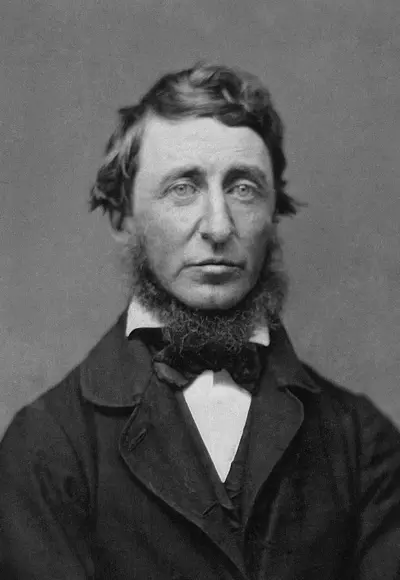
- Born: July 12, 1817
- Died: May 6, 1862
- Nationality: American
- Profession: Author
Henry David Thoreau was an American naturalist, essayist, poet, and philosopher. A leading transcendentalist, he is best known for his book Walden, a reflection upon simple living in natural surroundings, and his essay "Civil Disobedience" (originally published as "Resistance to Civil Government"), an argument for disobedience to an unjust state.
