Noam Chomsky Quotes
They [unions] used straight Marxist rhetoric [in 1930s] - just the values were changed.
Chomsky, Noam. Understanding Power: The Indispensable Chomsky. Edited by Peter R. Mitchell and John Schoeffel, The New Press, 2002.


He had squads of thugs that he would “rent” out to other gangsters for their enforcement activities and to unions to protect themselves from goons and intimidate non union workers. However, he would not let his men work as goons and strike busters or for companies—despite huge pay offers—to keep their workers in line, a common practice at the time.

Vladimir Lenin


Roosevelt shocked the conservative members of his own party with this statement. Labor unions were not then an accepted concept in American society. Anti trust legislation and enforcement was in its infancy and companies in an industry commonly conspired as to price fixing, labor negotiations and market share allocations. TR had a scrupulous sense of fairness and equity.


Ford was then 74 years old and had become a very different man than in his youth when he was the hero of labor. He was very paranoid at this time. He even thought that financiers were actually backing the labor unions because their purpose was to go to war against Hitler who Ford greatly admired and supported. See {642379}. He claimed that the way they would do it is to fund the labor unions so most workers would join unions. This he thought would eliminate competition and lower workers’ wages. When workers’ wages were pushed low enough, the workers would demand American entry into the war to create government spending on armaments and a labor shortage to drive wages up again. There was not a single financier who was actually paying or lending any money to labor unions, and most industrialists other than Ford complained that labor unions would always demand higher wages. Ford’s son Edsel was the chief operating officer of Ford Motor Company, and did his best to work around his father to keep the company healthy and deal with a terrible labor relations problem his father caused.


This quotation is extremely subtle. Vidal tells us that he has always hated organized labor. He also tells us that the media has always given us one monolithic view of organized labor. He is silent as to whether that view was accurate and justified or in his mind or whether he was just going along with the image created by the media. There is no answer, but it is a quotation that is food for thought. Numerous studies found that at the beginning of the 21st century, the public view of labor union crooked and/or communist leaders was much worse than reality.

The great union leader had been shot at though his home window in an attempted assassination. Fortunately, the bullet missed, but national tension was very high. In the half of the 20th century a not uncommon way of busting unions was to hire goons to assault and/or kill union leaders and organizers. A not uncommon method of putting pressure on companies was for unions to have goons sabotage machinery, burn facilities, and destroy or ruin inventory. The WWII period saw this class warfare violence for settling labor issues diminish greatly, and the attack on Reuther potentially might have been the trigger to return to the pre war days of much violence in labor disputes. Mrs. Roosevelt and other national leaders weighed in by many means to prevent that. They were successful, and although there have been a few throwbacks, the class warfare of physical violence is no longer a characteristic of American labor relations. The class warfare has moved to the courts, the lobbyists, campaign organizing and contributions and economic intimidation.


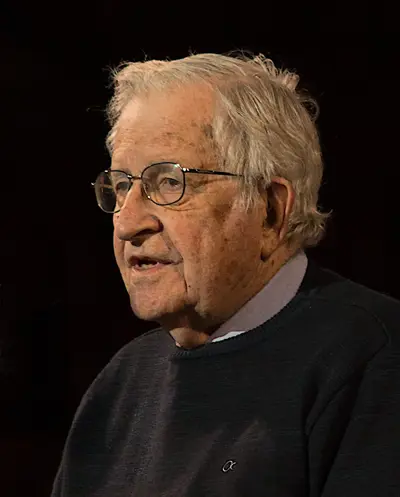
Avram Noam Chomsky is an American linguist, philosopher, cognitive scientist, historian, social critic, and political activist. Sometimes called "the father of modern linguistics", Chomsky is also a major figure in analytic philosophy and one of the founders of the field of cognitive science. He is Laureate Professor of Linguistics at the University of Arizona and Institute Professor Emeritus at the Massachusetts Institute of Technology (MIT), and is the author of more than 150 books on topics such as linguistics, war, politics, and mass media. Ideologically, he aligns with anarcho-syndicalism and libertarian socialism.
