Karl Marx Quotes
These numerous points at which money is withdrawn from circulation and accumulated in numerous individual hoards or potential money-capitals appears as so many obstacles to circulation, because they immobilise the money and deprive it of its capacity to circulate for a certain time.
Marx, Karl. Capital: Volume II. Progress Publishers, 1956, p. 268.


The colony, Darien, failed as the Spanish evicted the colonists. Yet Holland’s economic view of the advantages of international trade was remarkably prescient.


Mises defines government revenue in such a manner that it always relly belonged to individuals, therefore when government invests in enterprises that accumulate capital via profits, Mises does not consider it capital accumulation. One counterexample of this point is the George Washington Bridge in New York, built in Mises lifetime by Robert Moses of the New York Port Authority. The tolls on the bridge paid off the bondholders who financed much of the initial construction. But then capital started to accumulate at such a rapid rate that Moses was able to build other capital projects ranging from highways to the World Trade Center Buildings with capital constantly accumulated. The New York Port Authority under Moses generated more capital appreciation than any corporation that had been in existence at that point. And he could not even sell stock. However, the Port Authority and a few others were exceptions. Generally government did was unable to accumulate capital in its enterprises.


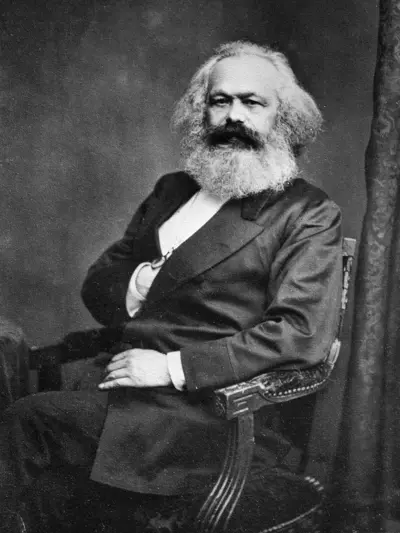
Karl Heinrich Marx was a German philosopher, economist, historian, sociologist, political theorist, journalist and socialist revolutionary. Born in Trier, Germany, Marx studied law and philosophy at university. He married Jenny von Westphalen in 1843. Due to his political publications, Marx became stateless and lived in exile with his wife and children in London for decades, where he continued to develop his thought in collaboration with German thinker Friedrich Engels and publish his writings, researching in the reading room of the British Museum. His best-known titles are the 1848 pamphlet The Communist Manifesto and the three-volume Das Kapital (1867–1883). Marx's political and philosophical thought had enormous influence on subsequent intellectual, economic and political history. His name has been used as an adjective, a noun, and a school of social theory.
