Niccolo Machiavelli Quotes
There never was a new prince who has disarmed his subjects; rather when he has found them disarmed, he has always armed them, because, by arming them, those arms become yours...
This view tends to be contrary to those gun control opponents who believe that dictatorial rulers always want to disarm a population. Historically that has occurred but more often, dictators arm their populations to accomplish their aggressive aims.
Niccolo Machiavelli, 1469-1527, Florentine statesman and political philosopher, The Prince
Sourced by: Eigen's Political and Historical Quotations


Stalin did not want any political opposition with its own militia. American gun control opponents often cite this quotation to show that in Russia, Stalin achieved dictatorial power by disarming the population in general and only allowing government officials to have guns. They argue that even Stalin could not have tyrannized the entire Soviet Union if every citizen had the right to bear arms as provided for by the Second Amendment.


She advocated armed self-defense for Blacks.

It would be more than a decade before the phrase “well regulated militia” would be added into the Constitution as the 2nd Amendment of the Bill of Rights. This resolution was the last of several passed at this meeting by which Maryland endorsed resistance to the British. So these resolations would have been widely distributed throughout the colonies and known by the leaders. In 1788 Alexander Hamilton Published Federalist 29 which also used the phrase. (See {588393}.) Then on September 25, 1789, the Congress proposed the Bill of Rights and the 2nd Amendment using the same key phrase, “well regulated militia.” Whether the drafters of the 2nd Amendment got the phrase from Hamilton’s Federalist 29 or from the Maryland Resolutions is not known but Hamilton’s was much more current. Did he get the phrase from Maryland? Did Congress get it from him? Did Maryland originate the phrase or was there an earlier use that influenced the Maryland drafters? At this point no one is sure, but the phrase is critical to the meaning of the 2nd Amendment because the Supreme Court has repeatedly held that the Second Amandment does not apply to individuals but only to the State’s right to bear arms within the “well regulated militia” and not as individual citizens. The right is that of the State government and that is why a state can control guns including banning them if they choose. So an individual in America does not have the constitutional right to bear arms. He may have a state constitutional right but in other states he may not use a gun in certain places and may not possess certain types of guns like hand guns which are illegal in New York, Washington DC and some other places.


While the militia had very few arms, Van Rensselaer had no military training and commanded a critical army because of his political connections—common at the time. After he botched the Battle of Queenston Heights he returned to politics but his military failure dogged him for the rest of his career. The quotation is yet another that illustrated the myth of all Americans armed and ready to fight for the nation. There was no gun culture then, and guns were expensive and a minority of Americans owned them. In this case less than 20 percent of the American militia owned a gun. And Congress would just not at the time spend the money for weapons.


Note the phrase “well regulated militia.” This is the exact same phrase which the Founding Fathers chose to use in the Second Amendment of the Bill of Rights over a decade later. And in this amendment the right to bear arms is provided for the “well regulated militia” and not for individuals as the Supreme Court has ruled many times. This quotation shows that the phrase was not just drafted by the founders, but had a clear and established meaning of which they were aware. Many people think that the phrase did not have a known meaning at the time but this quotation shows differently as the Constitutions of all the States were available to and studied by the Congress and most educated people.


This required much of the population to maintain and bear arms. Another part of the law required the arms-bearers to be at the service of the king and as such was the king's militia.

The speaker was specifically referring to the situation in Manipur India where there were several warring factions fighting for control.

He wrote this essay anonymously and signed it as “A Lover Of Peace”


This quotation is often provided by historians studying the gun culture of America. Even conservatives like Ames did not see a gun or an armed citizenry as important to America’s survival or well being. Contrary to popular belief, even the State Militias’ whose rights to bear arms was written into the Second Amendment did not bother to do so. In 1803 only three state militias had rifle companies. Firearms of the time were expensive, difficult to maintain, and hard to use. Unless one needed them for defense, it was too much of a bother. Even in the aftermath of the War of 1812 only 30% of Massachusetts adult men owned guns; by 1839, the rate was below 10%. It was on the frontier where guns were popular and necessary. See {613080}.

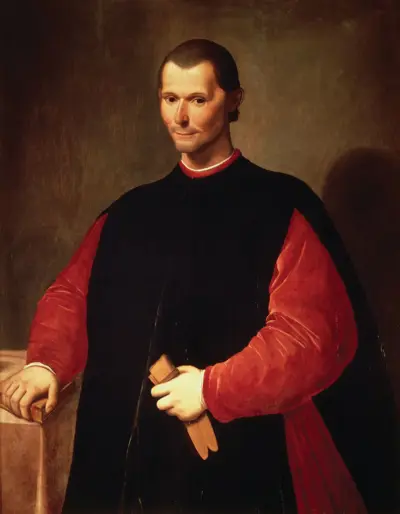
Niccolò di Bernardo dei Machiavelli was an Italian Renaissance diplomat, philosopher and writer, best known for The Prince (Il Principe), written in 1513. He has often been called the father of modern political philosophy and political science.
