Calvin Coolidge Quotes
There is no salvation in a narrow and bigoted partisanship. But if there is to be responsible party government, the party label must be something more than a mere device for securing office. Unless those who are elected under the same party designation are willing to assume sufficient responsibility and exhibit sufficient loyalty and coherence, so that they can cooperate with each other in the support of the broad general principles, of the party platform, the election is merely a mockery, no decision is made at the polls, and there is no representation of the popular will.
Calvin Coolidge, 1872-1933, 30th President of the United States (Republican, MA), Inaugural Address, March 4, 1925
Sourced by: Eigen's Political and Historical Quotations


When Roosevelt was elected Governor of NY State, the State Party Boss Platt saw patronage and contracts was the most important services the Governor should render to the Party. TR had a different view as expressed here.


This quotation had a close proximity to Lincoln’s Gettysburg Address (see linked quote). Although this was probably Lincoln's most famous line, it was not totally original. John Adams came close in a 1774 proclamation (see linked quote). As did John Marshall in his McCulloch v. Maryland decision (see linked quote). There was also Thomas Cooper in 1795 (see linked quote). But the earliest close phrase use appears to be the English cleric, John Wycliffe, in 1382 (see linked quote). It is not known with which of these Lincoln was familiar.

The Republican Majority of the House, when Hillary Clinton, the former Secretary of State, was running for President, established a select committee to investigate an incident that occurred in the State Department during Clinton's term. However, there already had been both House and Senate hearings and numerous investigations of the same incident. This committee uniquely was established with no deadlines to finish their work and an unlimited budget. Soon it became clear that the focus of the Republican efforts was on Mrs. Clinton and not on State Department activities except as how they might be negative to Clinton. Even leading Republicans admitted that the majority had abused its Congressional power to investigate to achieve primarily partisan advantage. See {582958} for Hanna's later statement when he incurred the ire of some of the Republicans for his admitting the truth.
In 2015, a group of hyper-partisan Republicans initiated yet another investigation of the attack on an American Consulate in Libya where the U. S Ambassador was killed. The incident had occurred when Hilary Clinton had been Secretary of State some time earlier. However, she was then the leading Democratic Candidate for President, and some Republicans wanted to question her under oath in the hopes that they could find something to embarrass her and derail her surging campaign. Hanna and a few other Republicans admitted the truth as they were opposed to the abuse of the Congressional power to investigate for partisan purposes. However, the reaction against Hanna by some members of his own party was extremely harsh. The theory of the Hanna critics was that telling the truth was in this case highly embarrassing to the Party and damaged the credibility of many accusations made against Mrs. Clinton who turned the tables on the investigators in when they questioned her for over 11 hours straight, and despite the total absurdity of the hearing and the questions—all of which had been asked before, she comported herself with Presidential dignity and pretended to take the hearings very seriously and answered the same loaded questions repeatedly. See {582957} for his earlier statements.


Lincoln won a resounding re-election victory in 1864. However, some of his Republicans had abandoned his cause and supported the Democrats. It was suggested that the dissenters be disciplined within the party.
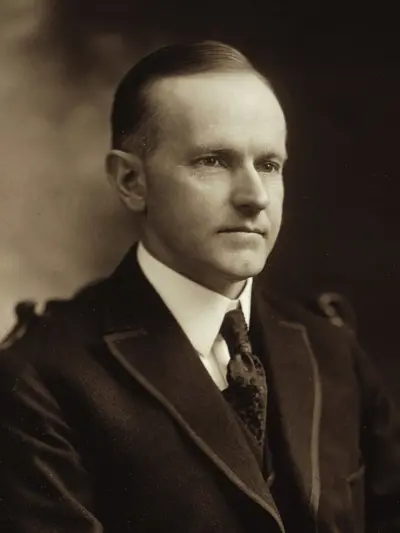
Calvin Coolidge was an American lawyer and politician who served as the 30th president of the United States from 1923 to 1929. A Republican lawyer from New England, born in Vermont, Coolidge worked his way up the ladder of Massachusetts state politics, eventually becoming governor of Massachusetts. His response to the Boston Police Strike of 1919 thrust him into the national spotlight and gave him a reputation as a man of decisive action. The next year, he was elected the 29th vice president of the United States, and he succeeded to the presidency upon the sudden death of Warren G. Harding in 1923. Elected in his own right in 1924, he gained a reputation as a small-government conservative and also as a man who said very little and had a rather dry sense of humor.
