Hezekiah Niles Quotes
There is no real difference between a set of bank directors, who make and issue notes … which they deliberately promise to pay with a previous resolution not to pay, and a gang of fair, open, honest, counterfeiters.
The Register was one of the most widely circulated journals of early America and Niles one of the most popular and influential journalists. Banks at the time could print their own paper money—unregulated by anyone. Often then did so knowing full well that if all the paper money they issued were presented for redemption they could not possible pay, as there was by the resolution of the bank directors not enough gold and silver to redeem all the money. Although few national leaders approved of the practice, it would have then been unthinkable and considered unconstitutional for the Federal government to interfere with a private bank’s right to print money or issue promissory notes regardless of the backing. See John Adams {615650} for a similar view.
Hezekiah Niles, 1777-1839, Editor and Publisher of Niles’ Weekly Register, Niles’ Weekly Register, 1818
Sourced by: Eigen's Political and Historical Quotations

Most of the Founding Fathers would be scandalized by the banking and finance system we have in modern times. There is not a single bank in the nation that would meet Adams’ criteria for not being a “cheat.” See {615649} for a similar view and {630666} for another quote by Adams regarding banks. Interestingly, Adams was a very conservative politician and generally supported the establishment, but banks at that time were not thought of as part of the establishment. They had a somewhat unwholesome reputation at best.
Most of the Founding Fathers would be scandalized by the banking and finance system we have in modern times. See {615649} for a similar view and {615650} for another quote by Adams regarding banks. Also {630667} for an Engish quote regarding banks. Interestingly, Adams was a very conservative politician and generally supported the establishment, but banks at that time were not thought of as part of the establishment. They had a somewhat unwholesome reputation at best.


The then attorney general had begun a series of investigation which discovered that most of the major Wall Street brokerage houses were engaged in systematic frauds to cheat small investors. One dramatic fraud he uncovered was that the research expert analysts of major firms would recommend the stock of businesses that their firm was doing investment banking for even when they knew that the companies were not doing well or were even in deep financial trouble. See {627544}.


This almost unbelievable memo was written by bank officials to help the bank’s mortgage sales staff cheat and “trick” the computer system which the bank used to determine whether or not a mortgage customer was worthy of mortgage credit. Why would the bank officials want their sales force to lie and “trick” their own system. In the Meltdown of 2008, most of the larger banks were REQUIRED to have a system to check the credit quality of the prospective borrower. However, the regulators never expected this kind of fraud from a supposedly reputable firm.


Each of the original American colonies was established with a different charter and had different structures. Pennsylvania was unlike the other colonies not chartered to a company or some other structure but was given completely to William Penn as his personal property. So there was never a Royal Governor appointed by the King or a Company for Pennsylvania. Technically Penn was the "True and Absolute Proprietor" where all of Pennsylvania was treated the same as a person's personal estate in England. William Penn was a very tolerant Quaker with strong democratic, and egalitarian beliefs. He established his estate with a legislature that had the power of taxation and the making of civil laws, defense and development. He was one of the great figures in the history of America. Philadelphia was the largest city in the colonies and the center of American science and culture. However, Penn's son, Thomas Penn was everything his father despised. He was aristocratic, arrogant, power seeking, vain and greedy. However, he had inherited Pennsylvania and was the proprietor. He saw the Pennsylvania Legislature and Franklin, one of its leaders, as the people who were running his private property. So Thomas Penn at this meeting took the legal position that his father did not have the authority to establish a legislature that had power; it could only advise the proprietor. See {583431} for Thomas Penn's statement that produced this reply.

Furgeson was running, with his wife as proxy, against the incumbent Texas governor who proudly announced that the state auditor had reported the state's books and budget were in balance.

Here is another example of “the good old days” phenomenon. Similar complaints are made in most generations about most vices.
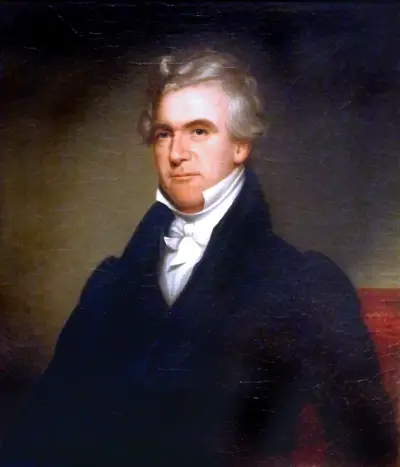
- Born: October 10, 1777
- Died: April 2, 1839
- Nationality:
- Profession: Journalist, Editor, Publisher
Hezekiah Niles, was an American editor and publisher of the Baltimore-based national weekly news magazine, Niles' Weekly Register (aka Niles' Register) and the Weekly Register.
