Jose Maria Aznar Quotes
There are the countries of the north of Europe taking decisions and the countries of the south of Europe that are living under intervention. This division exists.
Aznar, José María. Interview. Bloomberg Television, 26 July 2012.


The issue of free trade verses protectionism has been with us throughout American history with national sentiments going one way and then later the other, only to come back and the cycle has gone on. Floyd was very modern in his economic views, so much so that he, even as a Southern politician, opposed slavery on the grounds that it was economically inefficient and the South would never develop industrially if it had no incentive, as existed in the North and England, to reduce the amount of labor required for economic opportunity. He was right on that point as well.


Farmer was actually in jail in Louisiana for "disturbing the peace." The speech which he wrote was actually delivered for him by Floyd McKissick.


Fitzhugh was a Southern iconoclast whose view of Northern labor was much like that of Karl Marx but who was an enthusiastic supporter of slavery.


This was one of the perceived advantages of the South—that the North, with its more complex and sophisticated society, would pay a higher economic price by fighting than the South would. Southern whites didn’t work or farm much and they could fight and the older men and slaves could keep the agriculture and economy going. However, the huge superiority of the North in productivity and technology, in farming, manufacturing, transportation and military offset the Southern advantage do a great degree. But when the North attracted so many of the Southern Negro slaves to their lines, the Southern labor force was diminished greatly for the first time. And Sherman’s March showed how the entire Southern economy could be crippled and the war was strategically lost by the Confederates. The reality of superiority of the North and the attitude of elites like Emerson in freely discussing that fact, was resented by Southerners then and since. There is to this day a Southern resentment of intellectuals and highly educated people—a vestige of the reality of differences existing in the 1860s and since. It was not until the 1950s that the South started developing educational and cultural institutions and populace that is on a par with the rest of the nation. But the states which spend less per capita on educational and cultural institutions, tend to have the poorest educational attainments of their citizens and they are mostly states of the deep South where values are still somewhat different from the North.


After Roosevelt, most eras of American politics more or less followed the pattern Roosevelt described herein as a “calamity”, with the anger becoming more or less intense. Jefferson thought that these were natural divisions of politics in all societies--{604810}. The thing that masked this for years was race and slavery. In Lincoln’s time there were liberals and conservatives in both parties if race were ignored. In Theodore Roosevelt’s era, he, Taft and others were generally liberal reformers, while a large number of Republicans were conservative supporters of the status quo. Some democrats were radical reformers like William Jennings Bryan while others were arch conservatives. Until 1964 and the Civil Rights Act there were many conservatives in the Democratic Party, but almost all switched to the Republican Party in anger. The Republican conservatives tended to drive the Republican liberals out of the party and for the last part of the 20th century Roosevelt’s “calamity” well described the American political scene, and the anger increased carrying partisan bitterness into the 21st century.


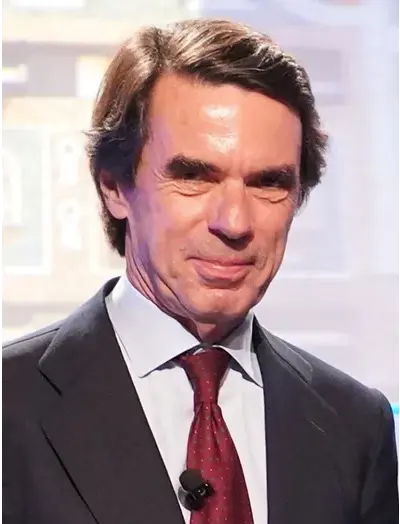
José María Alfredo Aznar López is a Spanish politician who was the Prime Minister of Spain from 1996 to 2004. He led the People's Party (PP), the dominant centre-right political party in the country at the time.
