Louis D. Brandeis Quotes
There are many men now living who were in the habit of using the age-old expression: 'It is as impossible as flying.' The discoveries in physical science, the triumphs in invention, attest the value of the process of trial and error. In large measure, these advances have been due to experimentation.
Louis D. Brandeis, 1856-1941, U. S. Supreme Court Justice, Dissent in New State Ice Co. v. Liebmann, 1932
Sourced by: Eigen's Political and Historical Quotations


Scientific breakthroughs depend on genius, circumstances, the work of others and serendipity. None of these are very predictable which is why it is do difficult to manage a scientific enterprise and be accountable for any results. See {624867}.


While this is generally true, from the scientific point of view, it is not quite right. The layman and most engineers believe that scientists discover things that exist. Although they do most of the time, breakthrough’s of the last century have for example discovered new chemical elements, but there are a few that science has CREATED—they exist nowhere in nature. Scientists are beginning to develop new life forms as well as discovering already existing ones. For over a century now the science of metallurgy has created thousands of alloys that did not previously exist.


Many of his greatest ideas were not sufficiently appreciated by many other scientists nor the businessmen who funded scientific projects then. Tesla was one of the great American immigrant scientists. He found in America the kind of intellectual and operational freedom that did not exist in the rigid, monarch-controlled, Austro-Hungarian Empire. He developed patents and techniques that formed the technological bases of radio, telephone long distance, TV, cell phones, Wi Fi, just to name a few. Most important he was Thomas Edison’s great nemesis. Edison invented DC electric generators that could power factories or entire streets in a neighborhood. Tesler invented and developed AC electrical technology which could power entire cities and he could move electricity over long distances which Edison could not. Tesler was one of the first scientists to conceive of and try to implement “Big Science” where there were huge capital investments to develop machines and systems to do what had never been done before—philosophically like the CERN Hadron Collider. Tesler even convinced a large corporation to finance the construction of a massive building and tower so he could experiment with the wireless transmission of electricity. However, as the industrial democracies have learned, Big Science can only be funded by governments and it often takes sever working in consort to afford the huge investment that is required. In Tesler’s era, the federal and state governments did not fund scientific research so his work was not only technically ahead of his time but also conceptually. He anticipated most of the problems and need for a national power grid that was challenging America even at the beginning of the 21st century.


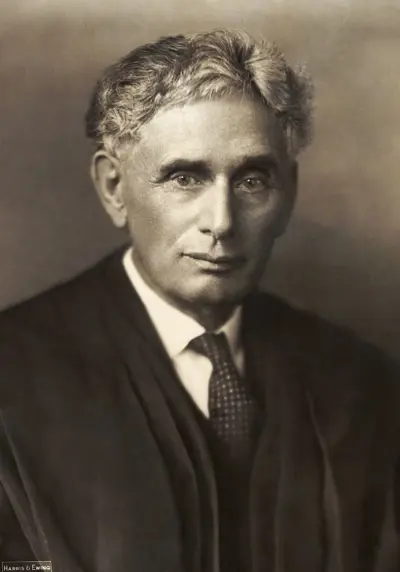
Louis Dembitz Brandeis was an American lawyer and associate justice on the Supreme Court of the United States from 1916 to 1939. He was born in Louisville, Kentucky, to Jewish immigrant parents from Bohemia (now in the Czech Republic), who raised him in a secular home. He attended Harvard Law School, graduating at the age of 20 with the highest grade point average in the law school's history. Brandeis settled in Boston, where he founded a law firm (that is still in practice today as Nutter McClennen & Fish) and became a recognized lawyer through his work on progressive social causes.
