Milton Friedman Quotes
There are four ways in which you can spend money. You can spend your own money on yourself. When you do that, why then you really watch out what you’re doing, and you try to get the most for your money. Then you can spend your own money on somebody else. For example, I buy a birthday present for someone. Well, then I’m not so careful about the content of the present, but I’m very careful about the cost. Then, I can spend somebody else’s money on myself. And if I spend somebody else’s money on myself, then I’m sure going to have a good lunch! Finally, I can spend somebody else’s money on somebody else. And if I spend somebody else’s money on somebody else, I’m not concerned about how much it is, and I’m not concerned about what I get. And that’s government. And that’s close to 40% of our national income.
AI Explanation: Milton Friedman explains 4 ways to spend money: 1) Spend your money on yourself (you will be careful about both cost and quality) 2) Spend your money on others (you care about cost, less about quality) 3) Spend someone else’s money on yourself (you care about quality, not cost) 4) Spend someone else’s money on others (you care about neither) The last one is how government spending works.
Milton Friedman, Interview by David Asman. Fox News, May 2004. The original is found in his book he co-authored with his wife, Rose Friedman, Free to Choose: A Personal Statement. New York: Harcourt Brace Jovanovich, 1980.


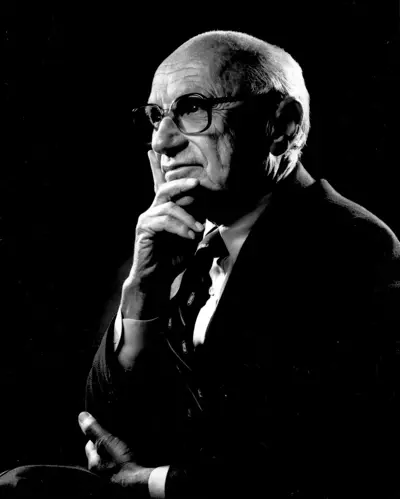
Milton Friedman was an American economist and statistician who received the 1976 Nobel Memorial Prize in Economic Sciences for his research on consumption analysis, monetary history and theory and the complexity of stabilization policy. With George Stigler and others, Friedman was among the intellectual leaders of the Chicago school of economics, a neoclassical school of economic thought associated with the work of the faculty at the University of Chicago that rejected Keynesianism in favor of monetarism until the mid-1970s, when it turned to new classical macroeconomics heavily based on the concept of rational expectations. Several students and young professors who were recruited or mentored by Friedman at Chicago went on to become leading economists, including Gary Becker, Robert Fogel, Thomas Sowell and Robert Lucas Jr.
