Bertolt Brecht Quotes
Then I will tell you something. I do not believe in it. Forty years among men has consistently taught me that they are not amenable to commonsense. Show them the red tail of a comet, fill them with black terror, and they will all come running out of their houses and break their legs. But tell them one sensible proposition, and support it with seven reasons, and they will simply laugh in your face.
Brecht, Bertolt. Life of Galileo. Translated by John Willett, Methuen, 1980, p. 30.


There are two general kinds of human action against their own interest. In the first find, citizens place the nation or the good of the community above their own personal advantage. Every soldier who voluntarily fights is engaging in this type of altruistic behavior. The other is where politicians, democratically elected or imposed offend people in some way. In a democracy people will vote against candidates whose policies are better for the individual, but he is offended by their corruption, immorality, racism, sexism or the like. Richard Nixon was turned on by the vast majority of Americans despite the fact that he presided over national affluence, and had by almost any standard made great breakthroughs in foreign policy. Another example is most of the Arab nations whose citizens support leaders who can and will not improve their standard of living but makes them feel good because they maintain Islamic dignity be opposing the West, even when the opposition itself makes development and growth much more difficult.


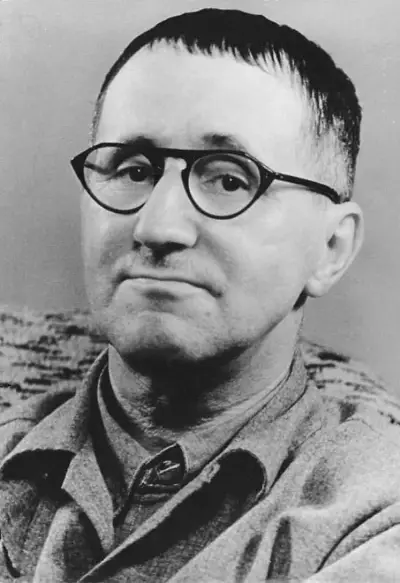
Eugen Berthold Friedrich Brecht, known professionally as Bertolt Brecht, was a German theatre practitioner, playwright, and poet. Coming of age during the Weimar Republic, he had his first successes as a playwright in Munich and moved to Berlin in 1924, where he wrote The Threepenny Opera with Kurt Weill and began a lifelong collaboration with the composer Hanns Eisler. Immersed in Marxist thought during this period, he wrote didactic Lehrstücke and became a leading theoretician of epic theatre (which he later preferred to call "dialectical theatre") and the so-called V-effect.
