Voltaire Quotes
The world embarrasses me, and I cannot dream that this watch exists and has no watchmaker.
Voltaire. Les Cabales. 1772.


This quotation is noteworthy because although there are some scientists who are sympathetic to the religious fundamentalist view of the origin of the universe, they are almost always second class scientists. In this case, the scientist is a first class scientist, a Nobel Prize winner in Chemistry. So his quotation has more weight than of most others and is used more often by many fundamentalists who support the Biblical Genesis version of creation rather than the Big Bang scientific explanations and evolution. There are however many great scientists who also are people of faith in a God. They may be religious, but like most religious Americans, interpret the Bible metaphorically and symbolically rather than literally as the fundamentalists do.


This quotation is very interesting in the light of the so called “intelligent design” opponents of evolution. Darwin himself was by no means an atheist but he did not see the “hand of God in everything about him”. He did not maintain that a God could not have a hand in setting the laws of evolution which then produced all the species. However, the modern proponents of “intelligent design” insist that the evolutionary mechanism is so complex that God must have a role in the processes themselves. There are atheist evolutionists and evolutionists who believe that there was a God or prime mover setting the laws of science in motion, but all so called intelligent design enthusiasts are religious and believe that God is involved in the process. They reject the scientific method and their assertions are not subject to scientific proof or falsification. They are not scientists in contrast to the scientists who believe there was a God or prime mover initiating the process.


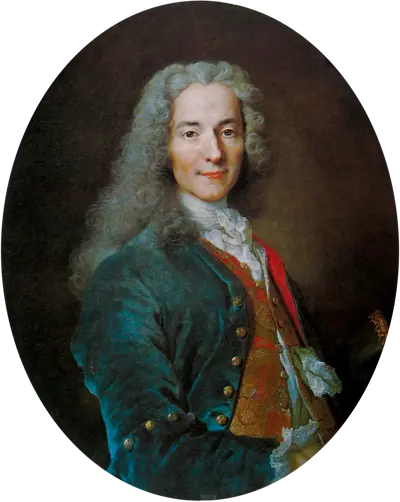
François-Marie Arouet, known by his nom de plume Voltaire (/vɒlˈtɛər, voʊl-/; also US: /vɔːl-/; French: [vɔltɛːʁ]), was a French Enlightenment writer, historian, and philosopher famous for his wit, his criticism of Christianity—especially the Roman Catholic Church—as well as his advocacy of freedom of speech, freedom of religion, and separation of church and state.
