Charles Darwin Quotes
I had no intention to write atheistically, but I own that I cannot see as plainly as others do, and as I should wish to do, evidence of design and beneficence on all sides of us.
This quotation is very interesting in the light of the so called “intelligent design” opponents of evolution. Darwin himself was by no means an atheist but he did not see the “hand of God in everything about him”. He did not maintain that a God could not have a hand in setting the laws of evolution which then produced all the species. However, the modern proponents of “intelligent design” insist that the evolutionary mechanism is so complex that God must have a role in the processes themselves. There are atheist evolutionists and evolutionists who believe that there was a God or prime mover setting the laws of science in motion, but all so called intelligent design enthusiasts are religious and believe that God is involved in the process. They reject the scientific method and their assertions are not subject to scientific proof or falsification. They are not scientists in contrast to the scientists who believe there was a God or prime mover initiating the process.
Charles Darwin, 1809-1882, English Scientist, Letter to American Asa Gray, May 22, 1860
Sourced by: Eigen's Political and Historical Quotations


At the time, it was very difficult for people who had been taught all their lives that God was directly responsible for the creation to accept the notion of evolution. At the time, there was not the overwhelming evidence proving Darwin’s theory that we have today. Nor did theologians realize that evolution and Darwinism were not inconsistent with the concept of a creator and supreme being. Nonetheless, there are still those who, like Agassiz, reject evolution and insist that the Biblical version of creation is literally true. See {586990}. Then there are people who have come up with the concept of Intelligent Design which originated with Agassiz though he never called it that. Most religious people today, in contrast, see no conflict in natural selection as described by Darwin and later proven, and the concept of God. They see the Biblical creation as metaphorical and natural selection as the product of an omniscient supreme being.


“Ichneumonidae" is the scientific name for a parasitic wasp that lays its eggs inside a live caterpillar and the baby wasps eat the capillary from the inside out. Darwin found it hard to reconcile why if God designed each of these species (the religious belief at the time), was there so much unnecessary cruelty in some animals. Surely, he thought God could have designed them to survive and thrive without so much cruelty. He acknowledged that God might have set a process in motion, but the development and evolution of each species he concluded was random within the scientific laws that governed. Darwin knew exactly what the effect of his publication of his findings and conclusions about evolution would have on the orthodox religious leaders of the time. Most of them were of his own upper class socioeconomic strata and he had studied theology. He delayed his publication for a quarter of a century while he muddled though, not the science, but the effect on the religious leadership and their consequent attacks on him for being an atheist. Asa Gray was a leading American scientist who was also a devout Christian.


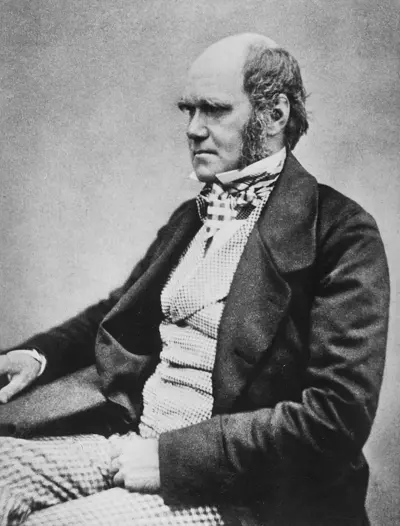
Charles Robert Darwin FRS FRGS FLS FZS was an English naturalist, geologist and biologist, best known for his contributions to the science of evolution.[I] His proposition that all species of life have descended over time from common ancestors is now widely accepted, and considered a foundational concept in science. In a joint publication with Alfred Russel Wallace, he introduced his scientific theory that this branching pattern of evolution resulted from a process that he called natural selection, in which the struggle for existence has a similar effect to the artificial selection involved in selective breeding. Darwin has been described as one of the most influential figures in human history, and he was honoured by burial in Westminster Abbey.
