Arthur Henderson Quotes
The vast upheaval of the World War set in motion forces that will either destroy civilization or raise mankind to undreamed of heights of human welfare and prosperity.
Henderson, Arthur. "Essential Elements of a Universal and Enduring Peace." Nobel Lecture, 11 Dec. 1934, Oslo. Nobel Lectures, Peace 1926-1950, edited by Frederick W. Haberman, Elsevier Publishing Company, 1972.

The Ambassador of Bavaria represented an area where the politicians saw democrats and socialists as their great enemy, as did many of the leading right wing conservatives in all of Germany. They believed that a great war would give them a chance to crush democratic socialism in Europe. Bethmann warned that just the opposite might result, and indeed it did. He was correct. Many of the crowned heads of Europe were deposed and the democratic socialists emerged as a major political factor in the victorious democracies. Bethmann-Hollweg, however, was not a strong leader and could not prevent the Conservatives, the military leaders, and Kaiser Wilhelm from initiating WWI.


Andrew Carnegie was then President of the New York Peace Society.


This phrase and the theory behind it are often misattributed to Samuel P. Huntington who first used it as the title of a talk at the American Enterprise Institute in 1992 and the following year used if as the Title of a very important article in Foreign Affairs. Huntington was very familiar with Lewis’ works and doubtless used the Lewis phrase as it perfectly fit Huntington’s concept. See {604193}.


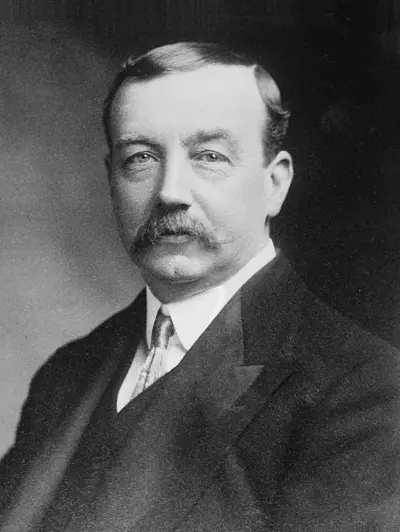
Arthur Henderson was a British iron moulder and Labour politician. He was the first Labour cabinet minister, won the Nobel Peace Prize in 1934 and, uniquely, served three separate terms as Leader of the Labour Party in three different decades. He was popular among his colleagues, who called him "Uncle Arthur" in acknowledgement of his integrity, his devotion to the cause and his imperturbability. He was a transitional figure whose policies were, at first, close to those of the Liberal Party. The trades unions rejected his emphasis on arbitration and conciliation, and thwarted his goal of unifying the Labour Party and the trade unions.
