Martin Van Buren Quotes
The United States have fulfilled in good faith all their treaty stipulations with the Indian tribes, and have in every other instance insisted upon a like performance of their obligations.
Van Buren, Martin. "Third Annual Message." The American Presidency Project, edited by Gerhard Peters and John T. Woolley, 2 Dec. 1839.


This law allowed the President to forcibly move entire tribes from their native lands to sparsely settled land in the West. Oklahoma became knows as Indian Territory as so many Indians were relocated there. The act, and this clause in particular, gave the President the authority over all Indian tribes in the nation and established the difficult if not impossible relationship between the Indian nations and the Federal government. The act—the last sentence of the quote—also ratified all treaties with the Indians and pronounced them inviolate. That was not to be.


The intentions of the Founding Fathers towards the Indians was decent, respectful, and well intentioned. However, there was not enough of a system of enforcement or the will to enforce when the greed of the average whites grew too great. Many settlers saw these vast lands and could not see any harm in using a few acres for their farm. And if there had been only a few, there would have been little trouble. However, the settlers kept coming and coming and soon the Indians began to push back. In a sense, it was a class problem. The members of the Continental Congress who wrote the Northwest Ordinance were educated, affluent men who had plenty of land. Most of the men who contested for the Indian lands had little land or were newly affluent and saw few limits to America.


The Cherokee's had fallen under the control of the Confederate military and Ross had urged Federal military protection for the tribe.


Marshall was in general very sympathetic with the Indians and their rights, but even for him the notion of treating the Indians as sovereign masters of all their lands was unthinkable.


This is one of the first Policy Statements of the new Republic about the Indians. Essentially, although the government policy was reasonable and fair, public opinion was totally different and the leadership could not persuade the people on this point. One complicating factor was the fact that most of the Indian tribes had overtly or covertly sided with the British in the Civil War. Many Indians were exiled to Canada. Even the Indians who were American allies, had their lands encroached upon however.

The Indians did not have the wheel when the whites came, but soon there were wagons, stage coaches and railroads.

Note that there was still a serious attempt to coexist with the Indians and to pay for lands that whites moved into. This would change radically in the administration of Andrew Jackson who would replace Adams.


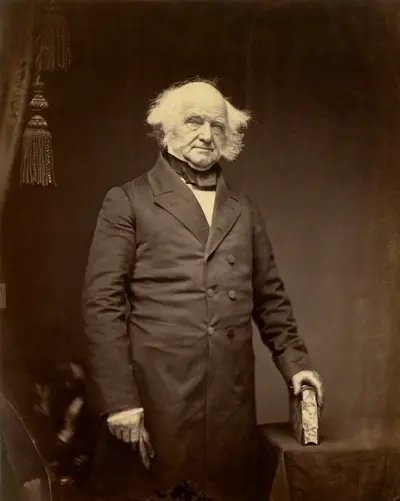
Martin Van Buren was an American lawyer and statesman who served as the eighth president of the United States from 1837 to 1841. A founder of the Democratic Party, he had previously served as the ninth governor of New York, the tenth United States secretary of state, and the seventh vice president of the United States. He won the 1836 presidential election with the endorsement of popular outgoing President Andrew Jackson and the organizational strength of the Democratic Party. He lost his 1840 reelection bid to the Whig nominee, William Henry Harrison, thanks in part to the poor economic conditions surrounding the Panic of 1837. Later in his life, Van Buren emerged as an elder statesman and an important anti-slavery leader who led the Free Soil Party ticket in the 1848 presidential election.
