John Tyler Quotes
The United States have adventured upon a great and noble experiment, which is believed to have been hazarded in the absence of all previous precedent - that of total separation of Church and State. No religious establishment by law exists among us. The conscience is left free from all restraint and each is permitted to worship his Maker after his own judgement.
Tyler, John. Letter to Joseph Simpson. 10 Jul. 1843. The Letters and Times of the Tylers, by Lyon Gardiner Tyler, vol. 2, Whittet & Shepperson, 1885, p. 354.

This is one of the key documents showing the “wall of separation of church and state” was in use in early America. Almost 200 years later the Chief Justice of the Supreme Court seemed ignorant of this communications. See William Rehnquist: {373663}


This quotation is one of the first to make the critical observation that the only time that tolerance of a religion is necessary is when there is an established church and others that deviate from it. If there is no established church, as the Founding Fathers envisioned, there is no preeminent church to do the tolerating. All are equal. In practice, Protestant churches were proportionately dominant in early America and up through the 20th century. So most of the issue of tolerance problems in America were cultural. And there is still a minority of Christians who believe that America should be a Christian country and other religions should be “tolerated.” However, Clinton and most of the founders did not want to see even general Christianity established as the national religion even they it was the majority religion.

At the time. Catholics in America were proportionately many fewer than today, and anti-Catholic sentiment and discrimination was very common. If the government then could become involved with religion, the protestant-dominated government would likely have restricted the Church and Catholics. So Catholics were, like Bishop England an absolutist for the separation of church and state. However towards the end of the 20th century, Roman Catholics were about 25% of the population and anti-Catholic sentiment was reduced to relatively few Protest extremists, who were rejected by the main stream even of Protestants. Then the Catholic bishops began to change their position and advocated Federal aid to parochial schools and various Catholic social services. They also began to lobby government to make laws enforcing the Catholic views of morality.


Madison, while a member of the House, had opposed the appropriation of funds for Congressional Chaplains and lost. Strict constructionists often quote his statements regarding Congressional Chaplains. Loose constructionists point to the fact that a majority of the Congress indeed appropriated the funds.

This may just have been a note to himself of a draft that he decided not to send. As with today, the people who would feel aggrieved by not being allowed to have Congressional Chaplains are much more passionate about the issue than the those who see Chaplains as unconstitutional. Thus Chaplains remain.


While this principle is very clear to us today, and was to the people who originally ratified The Constitution, there were many attempts by Christian groups to establish a privileged position for Christianity. For example, for years the Sunday Sabbath was legally enforced by unconstitutional Blue Laws that prohibited businesses from operating on the Christian Sabbath and prohibited activities that compete with Sunday church attendance. Supreme Court Justice Story even argued that the First Amendment allowed Christian religious supremacy and Cooley wrote this to refute Story’s now discredited doctrine.


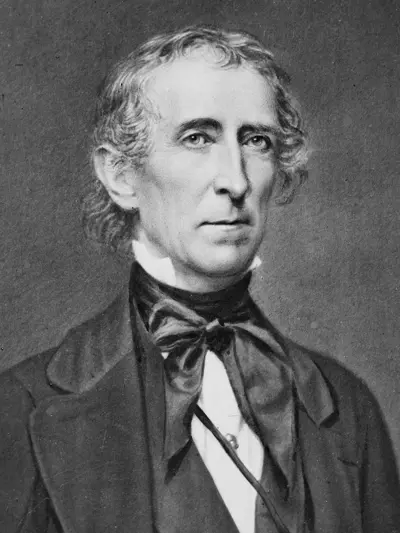
John Tyler was the tenth president of the United States, holding office from 1841 to 1845 after briefly serving as the tenth vice president in 1841; he was elected vice president on the 1840 Whig ticket with President William Henry Harrison. Tyler ascended to the presidency after Harrison's death in April 1841, only a month after the start of the new administration. He was a stalwart supporter and advocate of states' rights, and he adopted nationalistic policies as president only when they did not infringe on the powers of the states. His unexpected rise to the presidency posed a threat to the presidential ambitions of Henry Clay and other politicians, and left Tyler estranged from both major political parties.
