John C. Calhoun Quotes
The surrender of life is nothing to sinking down into acknowledgment of inferiority..
John C. Calhoun, 1782-1850, Vice President of the United States (Democrat, SC), U. S. Congressman & Senator (Democrat, SC), U. S. Congressman & Senator, Senate Speech, February 19 1847
Sourced by: Eigen's Political and Historical Quotations


Samuel Langhorne Clemens, 1835-1910. Twain was very perspicacious in observing that the populations of many countries often act against their own apparent material self interest in order to establish and feel a sense of dignity, manhood, honor or ethnic pride.


This text, generally considered the most important of all the Hindu works is believed to be the guidance given by Lord Krishna, the most important of the God figures, to has friend and devotee Arjuna. It originally was an episode of the enormous Mahabharata, the history of the ancient world written originally in Sanskrit. The date is approximate and different scholars have dated it from 500 BC to 50 BC. The Bhagavad Gita is generally regarded as the most concise description of Hindu philosophy. For Christians this notion is not a general one although it has evolved very strongly outside of religion in some subcultures such as Spain. But for Islam and the Hindu religion this notion is an integral component of the religious philosophy.


It was this code, and its implementation in Saipan, Okinawa, and other Japanese held islands taken by the allies that caused Japanese soldiers to fight to the death or commit suicide. The prospect of this code being followed by Japanese soldiers, civilians or both in an invasion of the Japanese mainland, was one of the major arguments in favor of dropping the Atomic Bomb in World War II.


At the beginning of the Job Corps, a number of academics and urban political figures were very critical of taking young men from the cities and brining them to rural centers in National Parks and Forests for basic education and work training. It was decided that instead of Sargent Shriver the Head of the Anti Poverty Program or Otis Singletary, the Jobe Corps Director, Eigen would give a major presentation at an academic conference ammouncing the scale and scope of the planned program. If the objection was too great, Singletary and Shriver could say that Eigen was just proposing his ideas that were under consideration but they had not reached a decision and Eigen did not prepresent the views of the administration. Fortunately he handled the critics well and was persuasive enough to oftain the support of many of the Conference attendees, and the Newspaper accounts were very favorible, so what Eigen said was the official policy and design of the Job Corps program which, with Head Start, were the only two programs for the War on Poverty that still opperated 60 years thereafter. Eigen told this story in a Primer he wrote for new Federal appointees who most often have little or no understanding of the operations of the Federal Government.


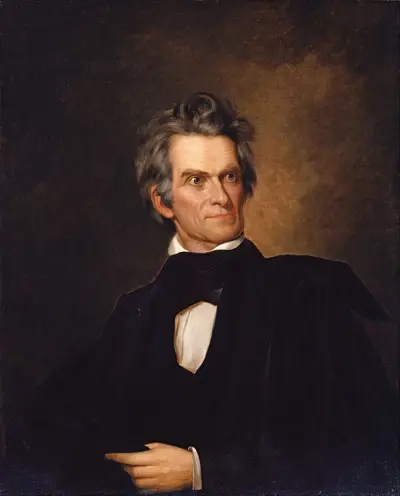
John Caldwell Calhoun was an American politician and political theorist from South Carolina who held many important positions including being the seventh vice president of the United States from 1825 to 1832, while adamantly defending slavery and protecting the interests of the white South when its residents were outnumbered by Northerners. He began his political career as a nationalist, modernizer, and proponent of a strong national government and protective tariffs. In the late 1820s, his views changed radically, and he became a leading proponent of states' rights, limited government, nullification, and opposition to high tariffs. He saw Northern acceptance of those policies as a condition of the South remaining in the Union. His beliefs and warnings heavily influenced the South's secession from the Union in 1860–1861.
