BHAGAVAD GITA
Song of the Lord
This text, generally considered the most important of all the Hindu works is believed to be the guidance given by Lord Krishna, the most important of the God figures, to has friend and devotee Arjuna. It originally was an episode of the enormous Mahabharata, the history of the ancient world written originally in Sanskrit. The date is approximate and different scholars have dated it from 500 BC to 50 BC. The Bhagavad Gita is generally regarded as the most concise description of Hindu philosophy. For some religions, fighting and war is not only permissible but can be a religious duty. Islam has the same notion. Christianity in contrast has had more of a theological struggle with war as a duty and even had to develop the concept of a “just war” to make fighting morally permissible. But this compunction, also shared with Buddhists and Bhai for example, is by no means universal. When religious Muslims fought religious Hindus as they have for over 1000 years, it is particularly difficult even today to make peace as so many on both sides see the battle as a religious duty.
This text, generally considered the most important of all the Hindu works is believed to be the guidance given by Lord Krishna, the most important of the God figures, to has friend and devotee Arjuna. It originally was an episode of the enormous Mahabharata, the history of the ancient world written originally in Sanskrit. The date is approximate and different scholars have dated it from 500 BC to 50 BC. The Bhagavad Gita is generally regarded as the most concise description of Hindu philosophy. For Christians this notion is not a general one although it has evolved very strongly outside of religion in some subcultures such as Spain. But for Islam and the Hindu religion this notion is an integral component of the religious philosophy.
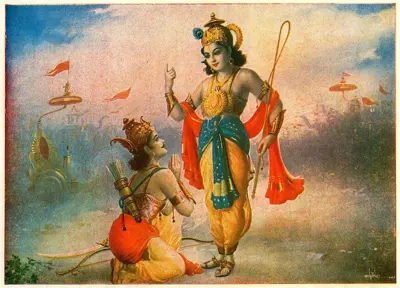
The Bhagavad Gita (/ˌbʌɡəvəd ˈɡiːtɑː, -tə/; Sanskrit: भगवद्गीता।, IAST: bhagavadgītā /bɦɐɡɐʋɐd ɡiːtäː/, lit. "The Song of God"), often referred to as the Gita, is a 701-verse Hindu scripture that is part of the epic Mahabharata (chapters 23–40 of Bhishma Parva), dated to the second century BCE. It is considered to be one of the main holy scriptures for Hinduism.
