Bhagavad Gita Quotes
Man is made by his belief. As he believes, so he becomes.
Song of the Lord
Bhagavad Gita, Sacred Hindu Text, 200 BC-200, For later expressions of this idea, See Otis Singletary {34339} Eddie Bernice Johnson {23542}, and John Stuart Mill {41699}.
Sourced by: Eigen's Political and Historical Quotations

He is one of the later people to express this idea but at the time, most political pundits and politicians were unaware of most of the others. See related quotes.

See Eddie Bernice Johnson {605259} & Barbara Tuchman {626144} for similar views and John Stuart Mill {607508} for an earlier expression. See {638618} for a Sociology principle that is similar. The earliest expression of the idea can be found in the Bhagavad Gita {594723}
Hitti was describing the Arabs but the principle would apply to almost any people. See {585931} for a political expression of this principle. Also {594723}, {607508} and {605259}.

See Otis Singletary {585931} for a different expression of the same idea and John Stuart Mill {607508} for the earlier expression. The earliest expression of the idea can be found in the Bhagavad Gita {594723}

Later American politicians expounded the same view. See Otis Singletary {585931} and Eddie Bernice Johnson {605259}. The earliest expression of the idea can be found in the Bhagavad Gita {594723}

See Eddie Bernice Johnson {605259} for a similar view and John Stuart Mill {607508} for an earlier expression. Otis Singletary for a contemporary one {585931} The earliest expression of the idea can be found in the Bhagavad Gita {594723}

See Eddie Bernice Johnson {605259} & Otis Singletary {585931} for similar views and John Stuart Mill {607508} for an earlier expression. The earliest expression of the idea can be found in the Bhagavad Gita {594723}


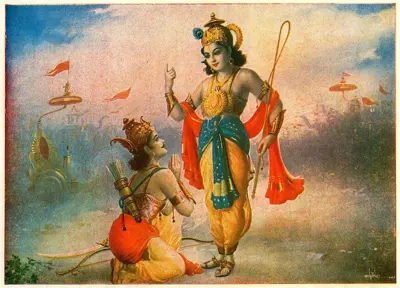
The Bhagavad Gita (/ˌbʌɡəvəd ˈɡiːtɑː, -tə/; Sanskrit: भगवद्गीता।, IAST: bhagavadgītā /bɦɐɡɐʋɐd ɡiːtäː/, lit. "The Song of God"), often referred to as the Gita, is a 701-verse Hindu scripture that is part of the epic Mahabharata (chapters 23–40 of Bhishma Parva), dated to the second century BCE. It is considered to be one of the main holy scriptures for Hinduism.
