Booker T. Washington Quotes
The social lines that were once sharply drawn between those who labored with the hand and those who did not are disappearing. Those who formerly sought to escape labor, now when they see that brains and skill rob labor of the toil and drudgery once associated with it, instead of trying to avoid it are willing to pay to be taught how to engage in it. The South is beginning to see labor raised up, dignified and beautified, and in this sees its salvation.
One of the vestiges of slavery in the South was the negative image that any kind of manual labor had. For whites, that is what slaves did, and for many still “should do”—not whites. For the Blacks, manual labor is what they had been forced and lashed to do, and “slowing down” their productivity was one of the only ways of rebelling. To work hard had been to capitulate to terror and evil. Both races and the economy of the South would suffer for more than a century after the civil war and in some parts of the South the attitudes were reflected into the 21st century.
Booker T. Washington, 1856-1915, President, Tuskegee Institute, “The Awakening of the Negro”, The Atlantic Monthly, September 1896
Sourced by: Eigen's Political and Historical Quotations


It has been true for most of American history with exceptions in depressions and some of the bad recessions. However after the 2008 economic meltdown of the George W. Bush Administration and the Great Recession that followed up to the time of this interview, it had not been true and one of Brooks' political objectives was to make it so again.


In 1877 Wasburn was dropped from the List of Ministers by the Unitarian Church. He had become quite atheistic.

Samuel Langhorne Clemens, 1835-1910. This quotation had even more meaning a century later when the gap in wages between a knowledge worker and a manual worker had increased many fold.

During Southern slavery, the poor white of the South had almost no prospects. He was always competing against slave labor which held his wages very low. At first he could he could get by if he had a trade—a carpenter, a blacksmith, a teamster, etc. However, soon slave owners invested in training some of their slaves, so even a white Southern tradesman could not earn a high wage as a Northern tradesman did. Unfortunately, the Southern upper class persuaded the poor whites that if slaves were emancipated they would be greater competition than they were under slavery, and there never was the common interest with the Northern labor that Emerson hypothesized.

Armstrong was a Union military chaplain with the troops that had captured Petersburg, Virginia. It is interesting how much he and apparently many of the Union Soldiers saw their part in the war as a crusade to reform the South. Also, note that although the South was fighting to preserve the slavery system that benefitted the rich, the rich often did not fight or join the military. Surprisingly to us today, if a man owned a certain number of slaves, he was then exempt from required military service.


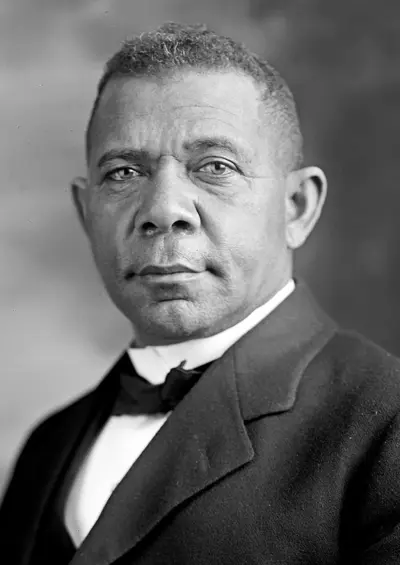
Booker Taliaferro Washington was an American educator, author, orator, and adviser to several presidents of the United States. Between 1890 and 1915, Washington was the dominant leader in the African American community and of the contemporary black elite. Washington was from the last generation of black American leaders born into slavery and became the leading voice of the former slaves and their descendants. They were newly oppressed in the South by disenfranchisement and the Jim Crow discriminatory laws enacted in the post-Reconstruction Southern states in the late 19th and early 20th centuries.
