Edmund Ludlow Quotes
The slaughter was continued all that day and the next, which extraordinary severity, I presume, was used to discourage others from making opposition. And truly I believe that this bitterness will save much effusion of blood. I am persuaded that this is a righteous judgment of God upon those barbarous wretches, who have imbrued their hands in so much innocent blood, and that it will tend to prevent the effusion of blood for the future which are the satisfactory grounds for such actions.]
This is an excellent example of a theme that has been used since biblical times to justify massacres by military men. Namely that if the first town that you conquer is treated terribly enough, the word will get around and the next town the people will pressure their military to surrender to avoid the same fate. Therefore, they argue, as Ludlow does, that the massacre will reduce future violence. That perverse ethical logic has lasted for a long time. However, that was not the only motive here—vengeance was a major factor. This is another good example of the fact that many of the worst moral atrocities of men were perpetrated and led by men who thought that there were being moral and consonant with God’s will. See {639301} for Oliver Cromwell’s description of the massacre.
Edmund Ludlow, ~1617–1692, English Parliamentarian & General, Member of the Long Parliament, Describing the Protestant Massacre of Catholics at Drogheda in 1649, Quoted in Jonathan Bardon, A History of Ireland
Sourced by: Eigen's Political and Historical Quotations

About 2000 Irish were slaughtered while Cromwell only lost 64. In the Irish Rebellion of 1641, many English Protestants—men, women and even children were massacred by Catholic rebels who were out of control of their leadership. See {639336} for an example. Cromwell, when he landed in Ireland with his troops, made no bones about the fact that he was there to avenge the massacres of 1641 {639283} . This was his first “payback”. 150 years later the Irish Protestants memorialize the massacres of the Rebellion of 1641. The Catholics, memorialize, the massacre at Drogheda. Each group uses these and other similar events to justify their positions of antagonism against the other. See {639282} for a moral analysis of Cromwell’s action here.

This is a description of a massacre of Protestants (mostly English) by Catholic Rebels led by Phelim O’Neill. The Catholics whose religion had been compromised when English King Henry VIII severed all ties to the Pope and the Vatican and bound the Irish to that decision of his. The Irish Catholic peasants so resented the English that their hate caused massacres like this in the Irish Rebellion of 1641. Their anger was so great that Phelim O’Neill and his officers lost control of their troops who were bent on revenge.


It turned out that it was that particular forester had approved the “use” of the national forest. FDR transferred much land from the Forest Service which was cozy with large economic corporate interests to the Park Service which then was not. Later, both would be or not depending on the leadership at the time.


On May 26, 1887 President Grover Cleveland, himself a Union Army Civil War veteran, issued an Executive Order providing that the captured Confederate regimental flags held as trophies by the War Department be returned to the States of the regiments from which they were captured. Union veterans were outraged:. Within three weeks the president rescinded the order, caving in to pressure from the major veterans organization of the day, The Grand Army of the Republic. Many years later President Theodore Roosevelt ordered the flags returned to the former Confederate states.


Roger’s Rangers of the French & Indian War were the first using unconventional warfare and invented the “deep raid” when they went in stealth all the way to Quebec and defeated the Abnaki Indians in their home village rather than defend against the Indians’ French coordinated attacks on upper York State. Rogers was portrayed by Spencer Tracy in the film Northwest Passage depicting the raid. All the men were killed but the women and children were captured and released with the exception of 5 teenagers who the Rangers took with them. This was one of the first formal “Rules of War” in what was otherwise a viciously uncivilized war.


New Ross was under siege by Cromwell and his English Parliamentarian troops. After two days, the town tried to negotiate terms of surrender and one of the main things they asked for was freedom of religion to practice Roman Catholicism. This famous response set the stage for religious bigotry over the next years. Cromwell’s reasons for not allowing Catholicism to be practiced was not only one of religious zeal. At the time, the Roman Catholic Church was a major geopolitical power under a Pope who commonly supported or even dispatched troops for geopolitical and religious ends. The Vatican was particularly resentful of England for separating from the Church and asserting that the King of England was the head of the Church and not the Pope. Therefore Cromwell and many Englishmen had to deal with the reality that every practicing Catholic in the realm was a potential spy, traitor, and/or rebel. This fear of control of countries by the Pope strongly affected America, and was responsible for the defeat of the first Catholic Presidential Candidate, Al Smith. It was also a major factor in the election of John F. Kennedy so he dealt with it head on.
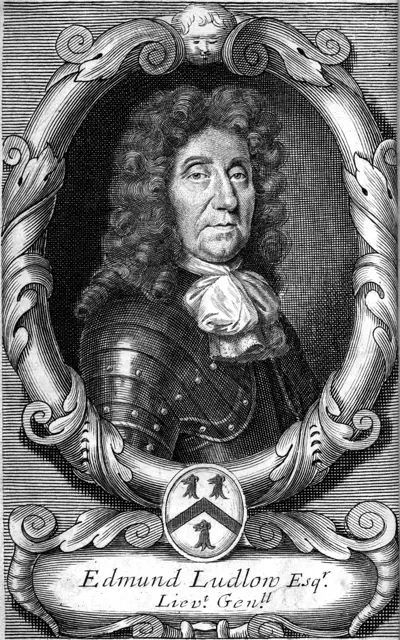
Edmund Ludlow (c. 1617–1692) was an English parliamentarian, best known for his involvement in the execution of Charles I, and for his Memoirs, which were published posthumously in a rewritten form and which have become a major source for historians of the Wars of the Three Kingdoms. Ludlow was elected a Member of the Long Parliament and served in the Parliamentary armies during the English Civil Wars. After the establishment of the Commonwealth in 1649 he was made second-in-command of Parliament's forces in Ireland, before breaking with Oliver Cromwell over the establishment of the Protectorate. After the Restoration Ludlow went into exile in Switzerland, where he spent much of the rest of his life. Ludlow himself spelled his name Ludlowe.
