Richard Thaler Quotes
The same with the mortgage brokers that were selling people mortgages they couldn't afford. We shouldn't pay them on each mortgage they write. They should have what they call "skin in the game," where they've got to reimburse us if the guy who sold the mortgage defaults.
Thaler, Richard H. Misbehaving: The Making of Behavioral Economics. W. W. Norton & Company, 2015.


This is typical of almost all government and semi government agencies. Does a government agency buy for as low a price as possible or give all a fair chance to compete, do police stop crime at the cost of impinging on civil rights, in the aftermath of the 2008 meltdown, does the government seek justice and punish the banks who caused the problem or build up the financial system so that investors and capitalists will have confidence and bring the system back to normal. Government, churches, charities and other non profit organizations all have this conflict between two or more duties and desirable objectives. This is one of the reasons that many of the great corporate leaders have failed in working for the government—they have difficulty coping with ambiguity and conflict of objectives. A company can ruin a community by moving a factory or office to a less expensive location, but generally the negative consequences are not major factors. For a government agency to ruin a community to save a little money is a much different matter.

This quotation is particularly interesting in it shows how far partisanship and ideology can go into deluding political perception. Wallinson is a man of integrity who we must assumed believed what he said. Yet in the 30 years he referred to, most had Republican Presidents and there were a number of Republican controlled Congresses. During all that time the Republican Party platform called for continuous deregulation. Every Republican President and even Democrat William Clinton has bragged about their success at deregulating the business and financial environment in America. During that period, left wingers paraded to testify to Congress that the deregulation policies and practices was in their view injuring the country, While there was great debate over the desirability of deregulation, virtually no elected politician of the left or right denied that deregulation was happening. The Chamber of Commerce during that time always complained that the deregulation was not occurring fast enough and consumer groups claimed the rate was too fast. Yet Wallinson instead of taking the position of most conservatives that the deregulation had little or nothing to do with the Financial Crisis of 2008, actually convinced himself that there had been no deregulation. Human perception of political reality can be easily altered by ideology. Similar delusions have also occurred for left wingers. It is the ideology who is vulnerable regardless of what the ideology is.

The result was regulation of the banks and the creation of the SEC to regulate the stock market, However, over the years, the regulations were not able to keep up with the sophisticated development of new forms of investments and financial instruments and the financial industry were able to speculate with other people’s money in ways that FDR and his reformers never imagined. Finally, even the regulation that did exist was weakened by the policies of the George W. Bush administration and the combination brought about the Great Recession of 2008 where the profits from excess speculation were privatized and the losses, socialized with the taxpayer and the American worker bearing the brunt while most of the speculators were bailed out and made more money than ever. The Obama administration tried to reform the situation, but was unable to put an end to the legal speculation with other people’s money or of having institutions that were “too big to fail.”

She was the only major Federal Official who did not support the bailouts of the banks and their bondholders and shareholders. Not one of her insured bank depositors lost their insured funds in the financial crisis. She protected them all but would not protect the banks themselves. Other officials did that and the following year the bank executives took the bailout money and paid themselves and others in the bank huge bonuses when the banks lost billions.
Better Markets is a non-profit, financial organization that lobbies for better and greater government regulation of the finance industry.

At this time it was 6 years after the Home Financing Crisis and the Meltdown of 2008 and despite tens of thousands of law violations by the bank, the Justice Department was finally finishing their investigations and requiring some penalties. Other negotiations with other banks were in progress, but no bank executives were going to jail for the millions they handled fraudulently, whereas a burglar who stole household goods would do jail time.


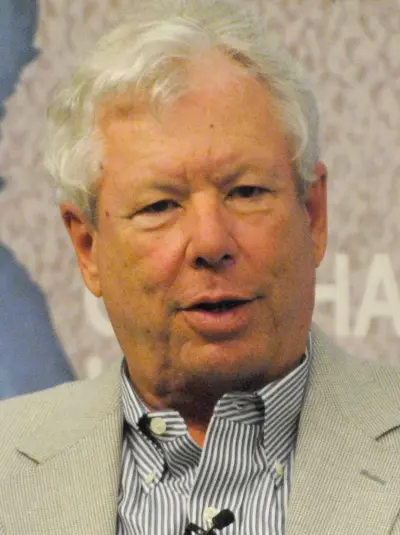
Richard H. Thaler is an American economist and the Charles R. Walgreen Distinguished Service Professor of Behavioral Science and Economics at the University of Chicago Booth School of Business. In 2015, Thaler was president of the American Economic Association.
