Pierre Beaumarchais Quotes
The respectful esteem which I have toward that brave people who so well defend liberty under your guidance, has induced me to form a plan of concurring in the great work by establishing an extensive commercial house solely for the purpose of serving you in Europe and supplying you with necessaries of every kind ... Your deputies, gentlemen, can find in me a sure friend, an asylum in my house, money in my coffers, and every means of facilitating their operations
Beaumarchais had established the commercial house of Hortalez and Company with which to procure supplies for the American Revolution. He was actually a secret agent of the French Government however he was not terribly secret about his dealings much to the chagrin of both the Americans and the King and Foreign Minister of France. This quotation from a letter he actually sent to the Secret Committee of Correspondence of the American Congress under the name of Hortalez and Company was his feeble attempt at spycraft to set up his cover and then even offer his cover as a “safe house” for American operations in France. See {624187}.
Pierre Beaumarchais, 1732-1799, French Playwright & Spy, Letter to the Secret Committee of Correspondence of the American Congress
Sourced by: Eigen's Political and Historical Quotations

Beaumarchais had provided the Americans with credit in the amount of ½ million French Livres. However, Beaumarchais served the French King Louis XVI as a spy and advisor on foreign affairs. The money had been secretly provided by the French government to help the American cause while still being able to officially deny to England that they were in any way involved in the rebellion. The American agent, Silas Dean, who arranged for the loan saw through the ruse. See {624186} and {624184}.


Beaumarchais had loaned the Americans ½ million French Livres. However, Beaumarchais served the French King Louis XVI as a spy and advisor on foreign affairs. The money had been secretly provided by the French government to help the American cause while still being able to officially deny to England that they were in any way involved in the rebellion. The American agent, Silas Dean, who arranged for the money saw through the ruse. See {624187} regarding the transaction. It was the first material aid that the French provided. Much more followed without which the American Revolution might never have been successful.


This is classic Roosevelt—optimistic but realistic at the same time.

The CIA has never denied this, and it seems to be corroborated in that none of the CIA reports to the Presidents ever mentioned the failures and there is no CIA official who ever claimed that they informed either of the Presidents. In particular, when Kennedy initially went along with the ill-fated CIA Bay of Pigs invasion plan not realizing that the CIA had a dismal record of major misjudgments and failures of covert operations.


Precursor to CIA. WWII had begun in Europe and England was under great pressure as Hitler threatened invasion and the German military had been successful everywhere they tried to invade. FDR had received an intelligence report and advice from our Ambassador to England, Joseph P. Kennedy (JFK’s father). He told the military, the State Department, and the President that England was finished—that they would not be able to stave off the coming German invasion. He predicted that Germany would set up a puppet state. Any help America could supply would not only be wasted but if material, would fall into the hands of the Nazis and be used against us. {610109} The military attaches attached to our Embassy in England generally agreed. However, the President knew that not only did Kennedy dislike Winston Churchill {613151}, but he had been an admirer not only of German Fascism, but Hitler in particular. Kennedy ran around with some of the wealthy, aristocratic English Fascists who were advocating a negotiated surrender to prevent English civilian casualties. So FDR sent his friend, Donavan, to make an independent Assessment. Donovan had served as an officer in WWI and had earned the Medal of Honor. This quotation was the summary of Donovan’s recommendation. Based on Donovan’s report, and other information, the president had gathered and his geopolitical judgment, FDR provided aid to England (Lend Lease) and fired Kennedy, who had disliked Roosevelt before and this turned to hate and became a vendetta for Kennedy thereafter, especially when his oldest son Joe volunteered to serve in the war, that the Ambassador had so viciously opposed, {610121} and then was killed while carrying out a very dangerous volunteer mission. {616651}.

This fact was one of the reasons that McCarthyism and HUAC were able to get traction. The Red Scare paranoids found something to really worry about. They overreacted, sensing the problem not as one of a large number of misguided and naïve people trying to help America do better, but as active spies controlled by the Kremlin who wanted to destroy the American way of life. There were two basic reasons these naïve officials acted that way. Many of them had not forgotten the devastation of the American people in the Great Depression and believed that capitalism had almost failed completely and the rough edge had to be taken off American capitalism by injecting some socialist principles such as stronger labor unions, ending racial and religious discrimination, controlling monopolies, and regulating critical industries. They also were mindful of the fact that the Russians were bearing the brunt of the WWII casualties—military and civilian—while killing more of the Germans and capturing more German occupied territory than the other allies together, yet they were not receiving the same level of assistance—technical, intelligence, economic and political as the British. They saw helping the Russians as saving American lives on the battlefield by making them more effective and keeping German soldiers and weapons away from the Western front and Americans. They also remembered that many in Congress were opposed to our entering WWII in Europe until Germany declared war on America. They had in many cases been apologists for Fascism and passionate enemies of communism. Some American industrialists like Henry Ford were anti-Semitic and overt admirers of Hitler. {586985} So these officials tried to redress the imbalance that existed while at the same time little was really known about Soviet Russia and the Stalin excesses that were as bad as some of Hitler’s. {634969} The only information Americans had were the terrible casualties the Russians were taking and the in kind that they were dishing out to the Germans. The number of Soviet spies in America were few and commensurate with the number of agents we had in Russia. But few Americans realized the difficulty the U. S. and the rest of the democratic world would have with Russia after the war was won.

July 4 is celebrated today, but the exact day has varied.

Vladimir Lenin

The profits that England made on the North American Colonies and the Caribbean were very large. 10 years before the American Revolution most sophisticated English politicians realized that and one of the reasons the British fought so hard to keep America from Independence was that money.


It was not published and distributed widely until 1774. Some of the Patriots of Early America realized that the oppressions of British rule were coming from Parliament and initially took the position that only the King could make laws for the colonies and not Parliament. Therefore, they were as Englishmen challenging illegal English laws. Most American hostility was directed at Parliament and not the King. However, once there was any physical resistance, King George came down with such a heavy hand that American hatred transferred to him. For related quotes on the King/Parliament issue, see {639145}, {639144}, {639143}, {639142}, {639141} & {639137}

The names cited were the British police and military forces. Fraternization was considered spying and brought death. That year the IRA executed over 100 of their fellow Irishmen, with no trial or chance to defend themselves. Some were scores and personal grudges being settled and others mistakes.

“The word “monitoring” is a polite diplomatic word for “spying on”. She made this statement in July of 2014 when the Germans discovered that the United States was spying on their government and ejected key Americans from the country. Albright was explaining that this is extremely common and “normal” between allies. See {640830} for more on this subject.

The 1st the CIA ever had. Popov was, in the 1950s, considered the CIA’s most valuable agent. He was motivated by deeply felt anger at Soviet exploitation of Russian peasants, including his family. He was caught and executed by Russian authorities in 1960. The quotation illustrates just how simple was his initial communication for spying.

Indeed his valet was a spy who worked for the British. However, Franklin assumed that European courts and capitals were filled with spies, and instead of trying constantly to ferret them out, he made sure that he never allowed anyone to know what he wanted to keep secret. While Jefferson essentially adopted the same viewpoint, John Adams, much more uptight and rigid, was very distressed with Franklin over their differences in counter-espionage strategy. In reality, no secrets ever leaked back to England, but their spies sent some of the most absurd reports of the “evil” Dr. Franklin. He was designing a huge set of lenses that could be pointed at the British fleet in the Channel, magnify the rays of the sun and set the ships ablaze. Another had Franklin designing a chain that would be stretched from France to England and an electric current transmitted thereupon causing the English island to blow up. These reports made Franklin and the French the first who were feared for their plans to design and deploy weapons of mass destruction.
This was the first American coin. It was issued by the Continental Congress, designed by Benjamin Franklin, and struck in Philadelphia. It was made of pewter, a cheap, soft metal that was not very durable. The double meaning of “Mind Your Business” on a coin is a typical Franklin effort.


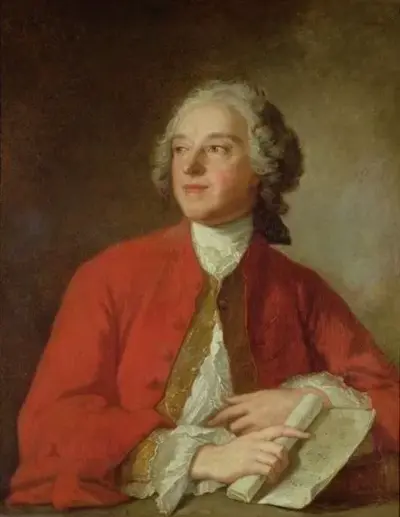
- Born: January 24, 1732
- Died: May 19, 1799
- Nationality: French
- Profession: Inventor
Pierre-Augustin Caron de Beaumarchais was a French polymath. At various times in his life, he was a watchmaker, inventor, playwright, musician, diplomat, spy, publisher, horticulturist, arms dealer, satirist, financier, and revolutionary (both French and American).
