Monte Melkonian Quotes
The relationship of a people to their homeland is crucial. A people will naturally have a difficult time maintaining a common cultural identity without a collective presence in their homeland. Only in its homeland can a people develop economically, culturally and socially as a homogeneous entity. In fact, this is the crux of why some of us consider it necessary to struggle to live in our homeland.
Note the belief that the author has the belief that over time homogeneity is important in a state, whereas the most successful modern states have been ones that are diverse—i.e. America, Britain, China, France. There have been some small successful states like Norway that are homogeneous, but large states need the heterogeneity.
Monte Melkonian, 1957–1993 Armenian Patriot & Nationalist, The Right to Struggle
Sourced by: Eigen's Political and Historical Quotations


This statement was more than a proverb but a popular political doctrine as well which had for years destabilized the Balkans. From the Serbian point of view, if a Serbian family moved to Bosnia or another country, their family land and their decedents were Serbian and under the governance of Serbia. Where there were enclaves of Serbs, they and the Serbian Government considered that land Serbian. This attitude even widely prevailed into the 21st century and led to the U. S. War with Serbia over the Serbian attempts to control parts of neighboring countries where Serbs were in the minority. The Serbs were not unique in this respect. Germany, in WWI, had seized territory from France because there were large enclaves of Ethnic Germans in the Sudetenland. The Ancient Romans likewise asserted the protection of Roman Citizens anywhere in the known world.
This mode of national definition is characteristic of many nations of Europe as well.


Very few countries make such overt recognition of the arts and their cultural heritage a part of their constitutions. Even nations which are fanatic about their cultures such as France do not have such overt constitutional provisions.

This parochial and sectional point of view was held much more strongly by the South and to a great extent, still is. We are all conflicted by wanting and American culture (that can be adopted by the world in globalization) and also wanting local customs, cultures, norms, policies and thought patterns to exist. However, there is inevitable conflict between the two, so it is a constant American source of debate, ebb and flow.


Historically, these were not countries like Egypt, Tunisia, Morocco or Iran. They were created artificially by the European powers in the 20th century.


His views are a mix of modernism and fundamentalism. He favors democracy and elections but also favored the Taliban destroying the great ancient Buddha statues when he was called an idol worshipper for urging the preservation of art.


After the WWI Turkish massacre of Armenians and the casualties of WWII, large numbers of Armenians were outside of Armenia which was a part of the Soviet Union and many ethnic Russians were moved into Armenia thus dominating the country. The ethnic Armenians found themselves a minority in their own homeland,
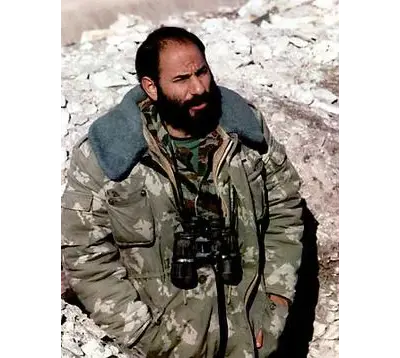
Monte Melkonian was an Armenian-American revolutionary, left-wing nationalist militant, and national hero. He was the leader of an offshoot of the Armenian Secret Army for the Liberation of Armenia (ASALA) in the 1980s and was a commander in the Armenian army in Nagorno-Karabakh fighting Azerbaijan during the First Nagorno-Karabakh War in the early 1990s. Melkonian left the United States and arrived in Iran in 1978 during the beginning of the 1979 Revolution, taking part in demonstrations against the Shah. Following the collapse of the Shah's monarchy, he traveled to Lebanon during the height of the civil war and served in an Armenian militia group in the Beirut suburb of Bourj Hammoud. In ASALA, he took part in the assassinations of several Turkish diplomats in Europe during the early to mid-1980s. He planned the 1981 Turkish consulate attack in Paris. He was later arrested and sent to prison in France. In 1989, he was released and in the following year, acquired a visa to travel to Armenia.
