Yoweri Museveni Quotes
The problem of Africa in general and Uganda in particular is not the people but leaders who want to overstay in power.
When he became president himself, he not only served 10 years but changed the constitution so that he could serve forever and was still President over 20 years later. See {620732} for another similar statement.
Yoweri Museveni, President, Uganda, Political Statement made early in his career
Sourced by: Eigen's Political and Historical Quotations

When he became president himself, he not only served 10 years but changed the constitution so that he could serve forever and was still President over 20 years later. See {636079} for a similar view of term limits

Porfirio Diaz - the longtime dictator of Mexico stole the election of 1910 and had his opponent Francisco Madero arrested and imprisoned. Madero got out, crossed the border to San Antonio, and issued this declaration which started the Mexican Revolution. See {613620} for the statement that declared the Revolution.


See {585638} for the kind of statement that led people to fear him as a dictator.


Actually the program had been taped earlier and on the day of broadcast, Biti had been arrested in Zimbabwe for ‘treason’ by the vicious dictator, Robert Mugabe, who had been beaten by the opposition in the election for the presidency but refused to relinquish power and in a stunning example of Biti’s point, the Electoral Commission never “officially” released the results showing that Mugabe had been defeated despite his control of all of the media, goon squads, and prohibition, intimidation and murder against opposition. See {619882}.

Description of Turkey's President, Recep Tayyip Erdogan. See 644169 for a quote about his popularity.

Commenting on the fact that China was eliminating it's Constitutional requirement that government leadership had to change every 10 years.

She was at the time the European Commissioner for Competition


“Personal government” meant to him charismatic individuals and demagogues who came to power in a republic and led it into a dictatorship. As opposed to representatives of political parties where a single individual could not control everything. However, this was before Adolf Hitler and his political party—the Nazis—came to power by election and turned Germany into a dictatorship. It takes more than structure to preserve democracy.


Lippmann was the most influential pundit of the time. Roosevelt had just been elected but had not yet assumed office. The country was in the midst of the Great Depression and many communities had 80% unemployment. Banks had failed, people were starving, and many people thought that democracy was just not suited to deal with such severe problems. Roosevelt, however rejected the advice and always worked through the Congress and in so doing saved democracy in America.


The Netherlands at that time had a representative republic, but whenever there were troubles, there were many who urged the appointment of a strongman—usually a prince or other noble. In the Dutch republic at the time, de Witt was the Chief Executive, but under their constitution, he could do little without the approval of the parliament. A strong leader with dictatorial powers was called for as there was little experience with a democratic republic and people did not have confidence that governance in a crisis was possible without dictatorial powers lodged in one man. Even in America, there tends to be more power taken by the presidency in time of war and other crises. So the fear and the argument has not changed in almost 400 years.

With so many revolutionary rulers of new nations suppressing all opposition, the history of Ataturk and Turkey is unique. Ataturk was so popular and his People’s Party so successful that there was no opposition and Turkey had one party rule. However, Ataturk was determined to have Turkey become a parliamentary democracy as good as the Western nations of Europe. So a tradition of multi-party democracy was needed. So Ataturk actually went to his friend Fethi Okyar and asked him to start an opposition party and oppose the government. Fethi was a strong supporter of the revolution and generally was in concurrence with Ataturk and the People’s Party on everything. Ataturk however convinced him that they had to start a tradition that would take Turkey through the future, and he did create a new party-- Serbest Cumhuriyet Fırkası (Liberal Republican Party) and worked hard to find differences with the People’s Party and the Government. One immediate contribution was the oversight that the new party provided—a strong tradition that exists to this day in Turkey.

El Baradei resigned when he made this statement. After the Arab Spring revolution, Mohammed Morsi had been elected President by a bare 51 pecent of the vote. However, he was a member of the political wing of the Muslim Brotherhood, an international terrorist organization which advocates Islamic Sharia and Theocracy. He began sizing powers and his government passed a constitution that did not guarantee basic human rights and moved towards a theocracy. Then he eliminated the checks and balances and the public finally revolted bringing 20 million Egyptians into the street in protest. A civil war was eminent and the military stepped in and forced Morsi to resign.
There was no semblance of democracy on Zaire. When he was more candid, Mobutu opposed democracy for Africa. See {628027}.
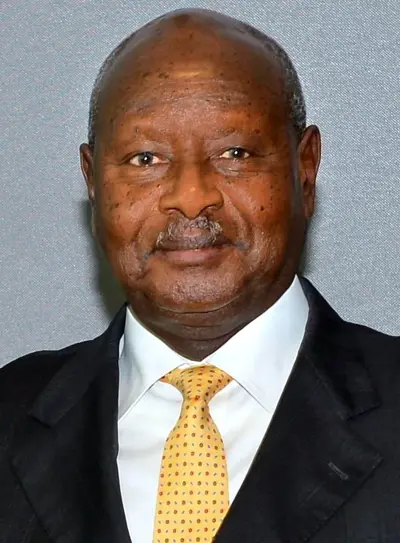
- Born: September 15, 1944
- Nationality: Ugandan
- Profession: Statesman
Yoweri Kaguta Museveni also known as Yoweri Tibuhaburwa Kaguta Museveni is a politician who has served as President of Uganda since 1986. Museveni was involved in rebellions that toppled Ugandan leaders Idi Amin (1971–79) and Milton Obote (1980–85) before he captured power in 1986.
