Ron Paul Quotes
The problem is that democracy is not freedom. Democracy is simply majoritarianism, which is inherently incompatible with real freedom. Our founding fathers clearly understood this.
Paul, Ron. "Democracy is not Freedom." US House of Representatives, Washington, D.C., 28 Jan. 2003.


This quotation is historically important because Davis clearly states the reason for the rebellion of the South. The anti-slave states were growing at a greater rate than the slave states and despite the greater voting power that a southerner had (a result of the 3/5 count of slaves for census purposes, and the Senate), the handwriting was on the wall and the majority of the United States was against the vicious institution of slavery and would make it unprofitable, impossible and/or illegal in the coming years. Southern slavery advocates saw this as a “tyranny of the majority” and therefore took up arms. In the early 20th century, apologists for the Southern rebellion tried to promote the idea that there were reasons other than slavery, but this quotation and the resolutions of the states who withdrew from the Union make it clear that the right to maintain slavery was the only significant issue. In that sense it was a States’ Rights issue, but the South was opposed to States’ Rights when it came to States refusing to return fugitive slaves when Federal Law required such under the Dred Scott Supreme Court Decision.


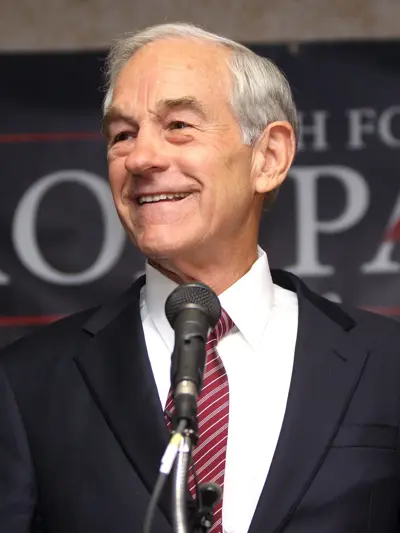
Ronald Ernest Paul is an American author, physician, and retired politician who served as the U.S. Representative for Texas's 22nd congressional district from 1976 to 1977 and again from 1979 to 1985, and for Texas's 14th congressional district from 1997 to 2013. On three occasions, he sought the presidency of the United States: as the Libertarian Party nominee in 1988 and as a candidate for the Republican Party in 2008 and 2012. A self-described constitutionalist, Paul is a critic of the federal government's fiscal policies, especially the existence of the Federal Reserve and the tax policy, as well as the military–industrial complex, the war on drugs, and the war on terror. He has also been a vocal critic of mass surveillance policies such as the USA PATRIOT Act and the NSA surveillance programs. He was the first chairman of the conservative PAC Citizens for a Sound Economy, a free-market group focused on limited government, and has been characterized as the "intellectual godfather" of the Tea Party movement, a fiscally conservative political movement that is largely against most matters of interventionism.
