Milton Friedman Quotes
The primary role of the economist is to find out the truth about the real world.
Milton Friedman, 1912-2006, Nobel Laureate in Economics, Statement as a young economist, Quoted by Alan Ebenstein, C-SPAN History, April 22, 2005
Sourced by: Eigen's Political and Historical Quotations


This quotation illustrates why so many consider Mises a political philosopher rather than an economist. In the latter part of Mises life and career, advances in mathematics and its application to economics revolutionized the field of economics and left Mises behind. Nonetheless Mises’ contribution to the non-quantitative area of economics was substantial, and his influence on others was even greater.


Critics of his wondered how he, a world class neurosurgeon, would react to a political proposal to “throw the neurosurgeons out and use common sense instead.
This quotation polarized the economists into those who thought that economics was held back by the rigidity of the scientific method and those who thought that economics was a backward science because it did not follow the standards of the more developed scientists. Scientists from other fields are almost universally in agreement and accuse many economists of making predictions and pronouncements from analyses that in other sciences would only be called guesses. The same is said of politics by many scientists.


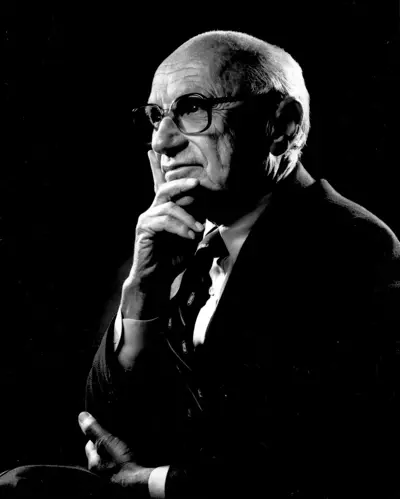
Milton Friedman was an American economist and statistician who received the 1976 Nobel Memorial Prize in Economic Sciences for his research on consumption analysis, monetary history and theory and the complexity of stabilization policy. With George Stigler and others, Friedman was among the intellectual leaders of the Chicago school of economics, a neoclassical school of economic thought associated with the work of the faculty at the University of Chicago that rejected Keynesianism in favor of monetarism until the mid-1970s, when it turned to new classical macroeconomics heavily based on the concept of rational expectations. Several students and young professors who were recruited or mentored by Friedman at Chicago went on to become leading economists, including Gary Becker, Robert Fogel, Thomas Sowell and Robert Lucas Jr.
