Robert M. Gates Quotes
The President should be very careful and reluctant to draw a line in the sand, but when he does so, crossing it must be fatal.
President Obama had publicly drawn a line in the sand stating the Syrian government must not use chemical weapons to put down the revolution and they went ahead and did it anyway. They did turn over all their chemical weapons to coalition forces, but Obama did not order any military or serious economic retribution for having dared to cross the line. The President argued that now that there were no chemical weapons in the hands of the government, the problem was solved. Many, including Gates, thought that this was a big mistake because American foreign policy and military prestige was at stake—that future presidents had diminished credibility because the United States might or might not follow through with their threats. See {642572} for a similar criticism.
Robert M. Gates, U. S. Secretary of Defense (Republican), Director of the CIA, Interview, PBS The Charlie Rose Show, May 18, 2015
Sourced by: Eigen's Political and Historical Quotations

See {641688} for a similar criticism of the Obama Syria policy.


Poincare and his policy advisors thought that the Germans were bluffing as they had in the past. This time they were not. WWI followed.


The Mormons have been the victims of more religious persecution and violence than any other religion in America. They became aggressive in defending themselves as this quotation illustrates.


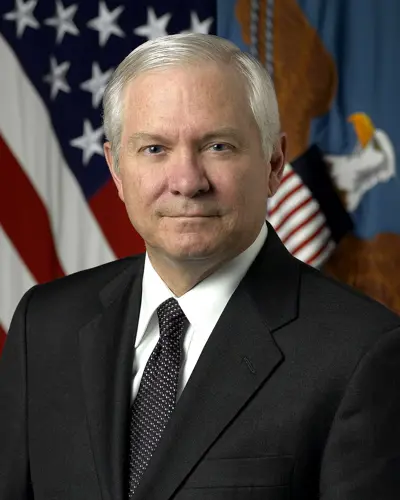
- Born: September 25, 1943
- Nationality: American
- Profession: Politician
Robert Michael Gates is an American intelligence analyst, and university president who served as the 22nd United States secretary of defense from 2006 to 2011. He was originally appointed by President George W. Bush and was retained for service by President Barack Obama. Gates began his career serving as an officer in the United States Air Force but was quickly recruited by the Central Intelligence Agency (CIA). Gates served for 26 years in the CIA and the National Security Council, and was Director of Central Intelligence under President George H. W. Bush. After leaving the CIA, Gates became president of Texas A&M University and was a member of several corporate boards. Gates served as a member of the Iraq Study Group, the bipartisan commission co-chaired by James A. Baker III and Lee H. Hamilton, that studied the lessons of the Iraq War.
