Ron Paul Quotes
The only true solution to the campaign money problem is a return to a proper constitutional government that does not control the economy. Big government and big campaign money go hand-in-hand.
His unusual theory was that if government could or did not do much to affect the economy, there would be no reason for a large corporation to invest money in electing a particular party or candidate. Therefore the way to get the influence of big money out of politics is to reduce the role of government drastically. Paul was one of the very few Conservative politicians who would publicly state that the reasons that corporations made campaign contributions was to buy political favors, favorable legislation or tax treatment. If corporate investments did not pay off for the company, shareholders would not tolerate spending investment money for a particular political philosophy as most companies have shareholders representing the range of American political opinion and their investments should pay off to the bottom line—profits.
Ronald E. Paul, U.S. Congressman (Republican, TX), Libertarian Nominee for President, Why Is There So Much Money in Politics?, February 4, 2002
Sourced by: Eigen's Political and Historical Quotations

At the time this was a very widely held, bipartisan view. See {634818} . Given statements like this, TR if he were alive today would never be able to get the Republican Nomination for President; nor could he obtain the Democratic Nomination because of his view on the military, expansionism, defense spending and war.


He had been serving as a University President. One change was the unlimited corporate funds that could then be donated to campaigns by corporations. “Super-Pacs” were one of these vehicles. Kerrey refused to use them. His opponent did not. His opponent was able to spend much more money on his campaign. Kerrey lost.


This is a very clever analogy to an aspect of astronomy and physics. Most of the mass in the universe is dark matter which is invisible to human sensors and instruments and hence cannot be seen. Yet they have the most gravitational effect on matter that can be seen.
The Citizens United case held that it was unconstitutional to limit the amount of money that corporations could spend political campaigns.
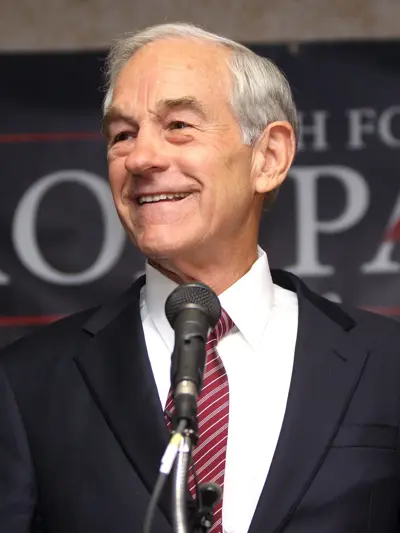
Ronald Ernest Paul is an American author, physician, and retired politician who served as the U.S. Representative for Texas's 22nd congressional district from 1976 to 1977 and again from 1979 to 1985, and for Texas's 14th congressional district from 1997 to 2013. On three occasions, he sought the presidency of the United States: as the Libertarian Party nominee in 1988 and as a candidate for the Republican Party in 2008 and 2012. A self-described constitutionalist, Paul is a critic of the federal government's fiscal policies, especially the existence of the Federal Reserve and the tax policy, as well as the military–industrial complex, the war on drugs, and the war on terror. He has also been a vocal critic of mass surveillance policies such as the USA PATRIOT Act and the NSA surveillance programs. He was the first chairman of the conservative PAC Citizens for a Sound Economy, a free-market group focused on limited government, and has been characterized as the "intellectual godfather" of the Tea Party movement, a fiscally conservative political movement that is largely against most matters of interventionism.
