Eric Schneiderman Quotes
For more than a century, states have sought to protect the integrity of the democratic process at the state and local level by regulating corporate spending in elections.
Schneiderman, Eric. "A.G. Schneiderman Statement On Supreme Court's Decision In American Tradition Partnership v. Bullock." New York State Office of the Attorney General, 25 Jun. 2012.


At the time this was a very widely held, bipartisan view. See {634818} . Given statements like this, TR if he were alive today would never be able to get the Republican Nomination for President; nor could he obtain the Democratic Nomination because of his view on the military, expansionism, defense spending and war.

Not only both parties agreed on the evil of corporate money in politics, but there was not even a single dissent on this point. Also, the President was in agreement {634816}. A century later, there were only a handful of senators who did not think that corporate money was critical in politics. This was a flip flop for BOTH major parties.


He had been serving as a University President. One change was the unlimited corporate funds that could then be donated to campaigns by corporations. “Super-Pacs” were one of these vehicles. Kerrey refused to use them. His opponent did not. His opponent was able to spend much more money on his campaign. Kerrey lost.


The Citizens United case held that it was unconstitutional to limit the amount of money that corporations could spend political campaigns.

His unusual theory was that if government could or did not do much to affect the economy, there would be no reason for a large corporation to invest money in electing a particular party or candidate. Therefore the way to get the influence of big money out of politics is to reduce the role of government drastically. Paul was one of the very few Conservative politicians who would publicly state that the reasons that corporations made campaign contributions was to buy political favors, favorable legislation or tax treatment. If corporate investments did not pay off for the company, shareholders would not tolerate spending investment money for a particular political philosophy as most companies have shareholders representing the range of American political opinion and their investments should pay off to the bottom line—profits.
The Supreme court ruled that monetary campaign contributions were a form of political speech and as such could not be limited. The result was that the richest people and the largest corporations could pay any politician any amount of money if the called it a campaign contribution. Under the Congressional rules at the time there were ways that the so called campaign contributions could be used for the legislator’s personal and family benefit and when members of Congress retired there were ways that they could take their “unspent” campaign funds with them for personal use. The resultant system was what Senator McCain called “bribery”, which before the Supreme Court rendered this decision was a felony. That which had been unethical and criminal became legal.

That particular Libertarian platform called for the abolition / repeal of Social Security, Medicare, Medicaid, the Post Office, Federal election Commission and campaign finance laws. Extreme radical ideas such as this are not typical of Libertarian Party positions before or afterwards. The quotation illustrates that there are people in America who would end public education if they could. The quotation also illustrates how a small cadre of people can capture control of a political party and create a platform that is their own personal views which may be different from most of the party members or the historical position that the party has taken. In 1980 the Libertarian Party Vice Presidential Candidate was David Koch, one half of the billionaire conservative Koch brothers. Their money financed the Libertarian Party in that year and David Koch’s views then prevailed in the party platform. Historically, the Koch brothers moved from a minor third party to the Republican party at the beginning of the 21st century when their money was able to help drive the party very far to the right from the traditions of Abraham Lincoln and Theodore Roosevelt.


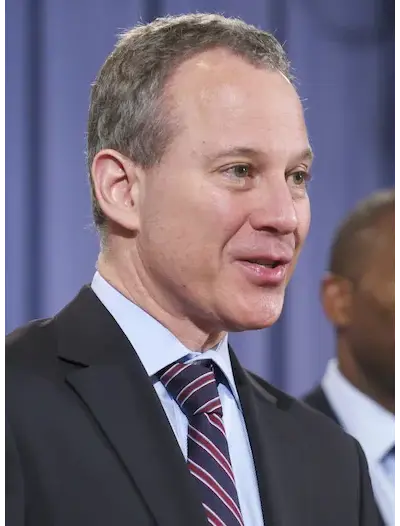
Eric Tradd Schneiderman is an American lawyer and politician who served as the 65th Attorney General of New York from 2011 until his resignation in May 2018. Schneiderman, a member of the Democratic Party, spent ten years in the New York State Senate. In May 2018, Schneiderman resigned his position as Attorney General after The New Yorker reported that four women had accused him of physical abuse.
