Thomas Friedman Quotes
The oldest civil war on the planet is the one between the Sunni and Shiites over who is the proper successor to the Prophet Muhammad.
Thomas Friedman, Foreign Affairs Columnist & Journalist, Interview, PBS The Charlie Rose Show, September 3, 2012
Sourced by: Eigen's Political and Historical Quotations


He coined the term “Shiite Crescent” in this quotation.


There is of course no way to tell the sect of a Muslim by physique alone, although there are major behavioral differences. The reason the quotation was newsworthy was that it was amazing that a senior Senate leader was so ignorant of such a critical and problematical subset of the world.


The implication of this sura is that it is permissible to kill non-Muslims but not Muslims. The same is true of slavery. Another prescription of this sura is that a Muslim should never kill another Muslim, so while this sura is very discriminatory and in that sense reprehensible, it does call into question the Islamic terrorist practice of the late 20th and early 21st century of killing fellow Muslims who might vote, serve in an official role or cooperate with non-believers. And it definitely to the Western mind prohibits the kind of Islamic sectarian violent practice of Sunni Muslims and Shiite Muslims torturing and butchering each other—a practice that has continued since the two groups fought over who was the rightful successor to Muhammad. The religious rationale for that murderous behavior is that each Islamic group sees the other as apostate and therefore no longer real Muslims.
The Interior Ministry has “responsibility” for the press in Saudi Arabia. Licenses are needed to publish a newspaper or magazine. The licenses are granted by the Interior Ministry. Editors keep close to Nayef and censor themselves based on his “guidance.” Wahhabism is a violent and fundamentalist version of Islam whose origins lay in Saudi Arabia. Ibn Taimaya was a 14th century Muslim cleric who preached a particularly radical form of Islam.

While the vast majority of Muslims had little or no thought of Islam ruling or even dominating the non-Muslim part of the world. But of the minority of the Islamic Religious Extremists, most saw a struggle with the Christians, Jews, and other religions of the world until Islam ruled the world—an outcome which most saw as inevitable.
A large part of the spread of Islam was military conquest and conversion by the sword. However, the Arabs and other people of the desert were great traders and the trade routes went right through the newly Islamic areas. As the camels went, so did the new Muslims and many converted because Islam was a more modern and humane religion than what they had, and in some cases the motivation was to be more acceptable to Arab customers.

While it may be true that some major powers do not presently want unity between Muslims, the Sunni-Shiite conflict has been ongoing for centuries—long before many “major powers” even existed. It is the oldest, continual civil war in history. It is certainly true that major Islamic powers like Saudi Arabia oppose unity was Saudi Arabia is a Sunni majority country and regard the Shiites as not only blasphemous and evil, but see them as dangerous.


Voltaire had little respect for any organized religion, but found Islam particularly barbaric and absurd. However he was also very negative about Christianity. See {621191} . The Ottoman Empire, centered in Turkey, then controlled all the Islamic countries of the Middle East. Europeans then often referred to all Muslims as “Turks.”


She was explaining her antipathy to Muslim Fundamentalists having French citizenship or even sing allowed into the country.
Ms. Moran would likely be outraged if a gun manufacturer would not sell her a gun on the grounds that as a Christian she can be assumed to agree with the dozens of verses in the Bible where God called on his followers to kill (and even mutilate), including the killing of insolent children. Most Christians do not take those commands literally just as most Muslims do not take her 109 verses literally. She also refused to allow brown skinned Hindus to patronize her range.

Historically, this quotation shows that the negative relationship between the West and Islam and negative views of Islam was not a new phenomenon at the beginning of the 21st century. It existed long before, and as with the 21st century concerns, violence and war were the major concerns.
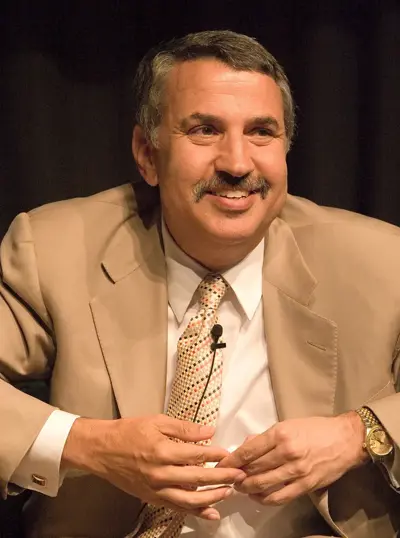
Thomas Loren Friedman is an American political commentator and author. He is a three-time Pulitzer Prize winner who is a weekly columnist for The New York Times. He has written extensively on foreign affairs, global trade, the Middle East, globalization, and environmental issues.
