Ruhollah Khomeini Quotes
The more people who die for our cause, the stronger we shall become.
Ruhollah Khomeini, 1900-1989, Iranian Cleric [Ayatollah] & Revolutionary Leader, Quoted in Robin Wright, Sacred Rage, 1985
Sourced by: Eigen's Political and Historical Quotations


Joseph Addison had earlier written of such a situation. Recent research has strongly suggested that Hale may never have said these words. The American patriots wanted to have heroes and may not have been too worried about the documentation and historical research. See {621112}


Song traditionally sung at the end of British Labour Party meetings


At that point the Japanese were losing the war on every front. It is not clear whether Hirohito would actually have done such and not tried to escape in the end, however he certainly expected his subjects, military and civilian to do so. That expectation and the behavior of the Japanese troops fighting to the death on many islands was a powerful factor in leading Truman, Marshall and other key American leaders to use the Atomic Bomb. See Marshall: {641063}

Quintus Horatius Flaccus. This famous quotation has been echoed in virtually every language and every country of the world. However, see Ernest Hemingway for a counter view.


It was a custom for suicide bombers in the Middle East to write or video record last words to loved ones.

Clark had Hancock and Adams for dinner. Paul Revere arrived to announce that “the British are coming.” The guests asked Reverend Clark if he thought that the people of Lexington would fight. They did, and some died.
Some apologists for the Muslim Brotherhood claim that the organization is social and political and not violent or advocates of terrorism. However, quotations like this one calls clearly for the sacrifice of lives. Hamas, a recognized terrorist organization is the Palestinian Branch and Offshoot of the Muslim Brotherhood which has never repudiated any of their terrorist murders and actively raises money for Hamas. See the original founding principle of the Muslim Brotherhood—{621776}

Compare Nathan Hale's last words.

Ataturk had been a military hero, but was very much opposed to war and military adventurism not unlike the Dwight Eisenhower and Colin Powell type leaders. However, the one thing that he thought worth the sacrifice of his own and other Turkish lives was Turkish independence and sovereignty. Historically, the Ottoman Empire which Ataturk finally ended, had dominated half of Europe and all of the Mid East at the cost of sovereignty of other nations and Ataturk saw no more important virtue with dying for than national sovereignty. See {125322} and {584501}.


It is hard to believe that there are any people in the world that would try and educate youth in this manner, but it is common amongst the ultra fundamentalist Muslims to day. However, it is very similar to what the Christians, including the Pope, preached a millennium ago and what the Japanese preached to their young Kamakasi in WWII.

Even as he was being executed for his many war crimes, the Field Marshal exhibited the mental perspective of Germanic patriotism that had brought Europe as well as Germany itself so much death and ruin.


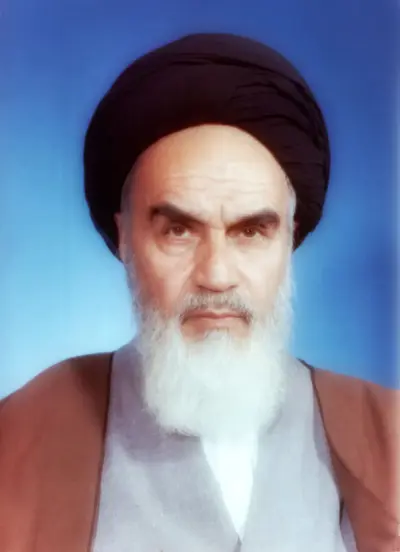
Sayyid Ruhollah Musavi Khomeini, also known in the Western world as Ayatollah Khomeini, was an Iranian political and religious leader. He was the founder of the Islamic Republic of Iran and the leader of the 1979 Iranian Revolution, which saw the overthrow of the last Shah of Iran, Mohammad Reza Pahlavi, and the end of the 2,500-year-old Persian monarchy. Following the revolution, Khomeini became the country's Supreme Leader, a position created in the constitution of the Islamic Republic as the highest-ranking political and religious authority of the nation, which he held until his death. Most of his reign was taken up by the Iran–Iraq War of 1980–1988. He was succeeded by Ali Khamenei on 4 June 1989.
