Ferdinand Foch Quotes
The military mind always imagines that the next war will be on the same lines as the last.
Ferdinand Foch, 1851-1929, French General, Quoted in Seldes, The Great Quotations, Citadel, 1983
Sourced by: Eigen's Political and Historical Quotations

Tojo was a hawk and didn’t want the flawed findings going to other cabinet members.


This issue of who has the wisdom and competency to determine policy in matters of war has been a constant one in most societies. Even in the Iraq war of the early 21st century, the Congress and the President argued as to what competence the Congress had to determine policy, strategy and tactics.


He lost the vote on this issue, and the Congress created the first committee to investigate and oversee military affairs.

“There” referred to the new American Colonies. He was advocating mobilizing the poor and destitute of England and sending them to America to provide manpower for a needed workforce and to be soldiers in the event of wars. The poor have historically been used indiscriminately for military manpower needs until Post WWII America where the military technology began to require minimum standards of intelligence and literacy. With the all volunteer military and higher standards, the majority of the military in America has been from the lower socioeconomic classes.


He later provided a copy to Hezekiah Niles, February 5, 1819 which is the source of the quotation since Henry never mentioned it.


3 years later he led America on a huge invasion and nation building project in Iraq. It turned out that had he listened to his own advice and not flip-flopped, the huge cost of the Iraq War might have been avoided.


Ivan Khrfistoforovich Bagramyan. Most militaries including ours have generally been trained and equipped for the last war and not the next war.

If a military loses a war, it has shown to be insufficient quality; if it wins, the evaluation is good. With all the talk about what makes for an effective and quality military, as the General states, it is war that is the final arbitrator. So ideally we never want to really know how good our military is.

Ruling group of France during the French Revolution. The purchase and transportation of an army in the field was a very expensive element of war and was very difficult as well. The Directory urged its generals to live off the land and get their food from the enemy country they were invading. Rarely did they pay for it but typically just took it from the civilians. Napoleon who served under the directory took this principle one step further. He also stole the invaded country’s art—paintings and statues mostly. These he sent back to Paris where they were sold to rich people. This way he could pay the salaries of the troops and buy more weapons and ammunition. Napoleon could conquer so much territory because France did not have to pay for the military effort as other countries did. This is one of the major reasons for example that the Louvre Museum in Paris has so many great Italian and Spanish paintings.


Much of the Chinese military had been distracted from military readiness in favor of political, economic, and ceremonial, activity along with extensive economic corruption. The People’s Liberation Army is a major political force in China which made this a very noteworthy chastisement. Leading Generals were with him however. See {632518}.

The War Plan that the Germans had developed--{642092}—had gone awry at the battle of the Marne in late 1914.


1st Baron Verulam. While most agree with the importance of this principle, it is easy to say and very hard to do. Appointing or electing leaders for wartime situations has always been difficult as it involves predicting how people will behave in the future. In WWII for example, many American and German Generals were fired. Adolf Hitler was the classic example of a very popular politician and demagogue who did not have a steady hand but whose maniacal lurches actually weakened the German military effort despite the morale contribution his popularity made.

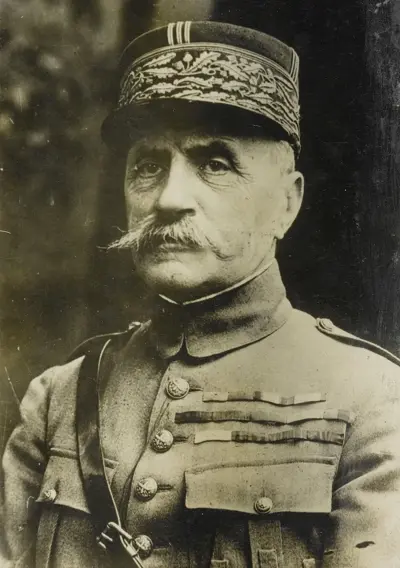
Ferdinand Foch was a French general and military theorist who served as the Supreme Allied Commander during the First World War. An aggressive, even reckless commander at the First Marne, Flanders and Artois campaigns of 1914–1916, Foch became the Allied Commander-in-Chief in late March 1918 in the face of the all-out German spring offensive, which pushed the Allies back using fresh soldiers and new tactics that trenches could not contain. He successfully coordinated the French, British and American efforts into a coherent whole, deftly handling his strategic reserves. He stopped the German offensive and launched a war-winning counterattack. In November 1918, Marshal Foch accepted the German cessation of hostilities and was present at the Armistice of 11 November 1918.
